The Research Behind Building Trust Faster, with Susan Baier and Hannah Roth
Episode 189

Quick answer. Susan Baier, CEO and founder of Audience Audit, argues that agencies now start from distrust, so trust has to be built long before a first sales conversation. Her formula for any piece of thought leadership has three parts: a data point, your reflection on it from experience, and advice your audience can use. In this episode, Susan Baier and Hannah Roth also discuss plans for a five-year study on how agencies build trust with cold audiences.
Sell with Authority Podcast, Episode 189 · Guest: Susan Baier, CEO and founder of Audience Audit · Hosted by Stephen Woessner with co-host Hannah Roth, Chief Strategy Officer and Partner at Predictive ROI · Published December 3, 2025 · Run time 42 minutes · Last updated November 27, 2026 · Part of the series on trust in the agency sales process
Why Do Agencies Start From Distrust?
Susan Baier’s answer is that buyers now assume they are being misled. She says, “The baseline these days is distrust,” and points to Edelman’s research showing that a majority of people believe business leaders are intentionally trying to mislead them. The 2025 Edelman Trust Barometer puts that figure at 68%. Her conclusion for agencies: being nice people is not enough, and an agency can no longer assume trust is already there.
“The baseline these days is distrust.”
How Does Research Build Trust Before the First Sales Conversation?
Research builds trust when it shows prospects that an agency understands where they already stand. Susan Baier and Hannah Roth cover four parts of that idea.
1. Flip the Research Question
Most agencies ask what they can learn about an audience. Susan Baier says the more useful question for thought leadership is what that audience assumes and expects about agencies like yours, and where trust is already weak. Audience Audit specializes in attitudinal segmentation, which studies why people think the way they do. As she puts it, thought leadership is about building trust, and that “is not a one way road.”
Ask what your audience already assumes about agencies like yours.
2. Turn Data Into Thought Leadership With Three Parts
Susan Baier says new data is irresistible to an audience, and it is still the smallest of the three parts that move people to trust you:
- The data. Start with a data point. It does not have to be your own research.
- Your reflection. What the data means, given your years of experience with clients and prospects.
- Your advice. What your audience should do about it to help their business.
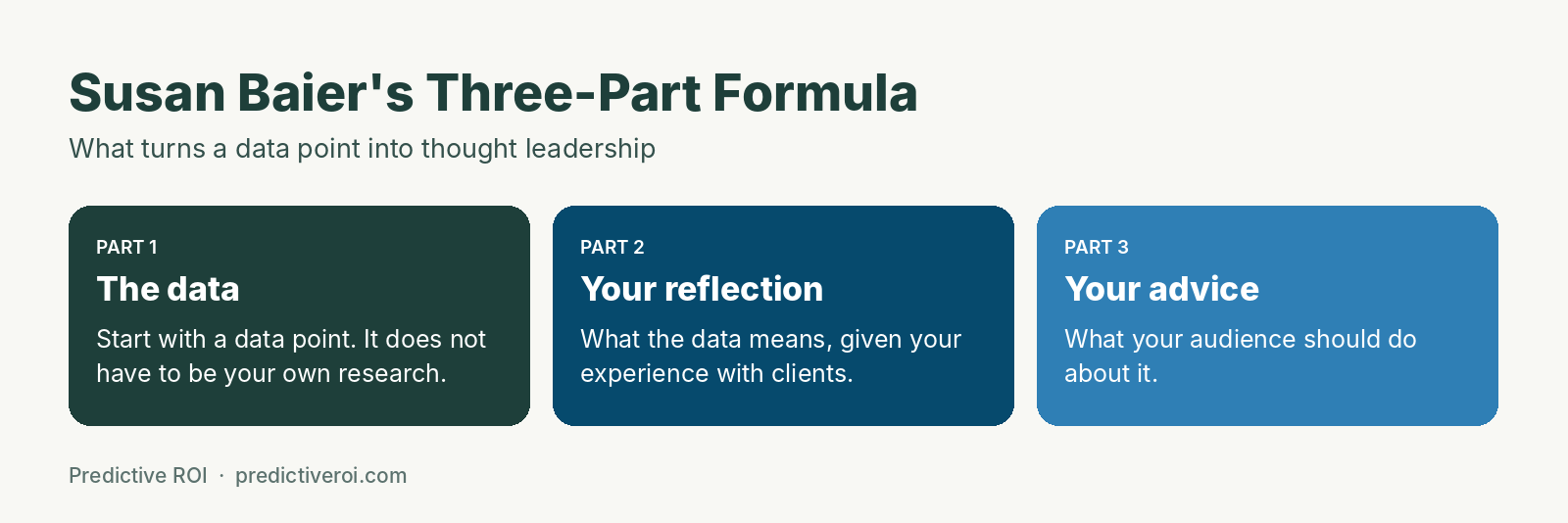
Her summary of what the formula asks of an agency: be authentic, have something new to say and be helpful. Her rule on what to share is short.
“Give away what you know.”
3. Start Earlier Than Feels Necessary
Susan Baier says in the episode that 77% of the decision in a B2B vendor relationship is made before the seller knows a prospect is looking. Her advice is to deliver the formula far earlier, and to keep being helpful without selling. She warns that agencies that wait for prospects to show up will never meet many of them, because those buyers have already chosen someone else.
A prospect is “a customer who hasn’t learned to trust you yet.”
4. Earn Two Actions From a Cold Audience
Hannah Roth explains why the planned study focuses on cold audiences. Technology makes the world feel smaller, and buyers feel more disconnected, with far more noise competing for their attention. Susan Baier adds that trust with a cold audience shows up as two actions: the moment someone gives you something personal, such as an email address, and the moment they reach out about buying. She notes that reputation drives both, and that what other people say about an agency matters more than what the agency says about itself.
“If you could get them cold, you already know what to do for the warm people.”
What Is the Five-Year Trust Study?
In this episode, Predictive ROI and Audience Audit share plans for a five-year longitudinal study of how agencies can build trust faster with a cold audience. Stephen Woessner frames it as a move “from practice to proof.” Two things set the design apart:
- It would survey the buyers: CEOs, CMOs and senior marketing leaders who hire, retain and sometimes fire agencies. It would not survey agency professionals.
- It would repeat core questions every year, so changes can be tracked over time, while other questions dig into what the previous year revealed.
Hannah Roth describes the difference as an album of photos instead of a single snapshot. What she most wants to learn is which outreach actions buyers welcome, because many agency leaders hold back for fear of being annoying. Susan Baier wants to learn what makes the path to yes faster for both sides. She also describes the mindset behind the work: the team goes in “trying to prove ourselves wrong.”
Editor’s note, November 2026: this study has not yet been fielded.
What Did Agency Clients Say About Agencies Using AI?
Susan Baier shares a finding from the Agency Edge research she conducts with Drew McLellan of Agency Management Institute. Many agencies stayed quiet about using AI because they feared clients would fire them and do the work themselves. She says the research found the opposite for the vast majority of respondents: clients want their agencies to step in, lead and be helpful. She offers it as an example of how an untested assumption can shape the way an agency sells.
She also describes the Agency Core study she conducts with Brian Gerstner of White Label IQ. In it, she says, an overwhelming majority of agency leaders expect their role to change a great deal. Her takeaway is that agencies need resilience more than one good year.
What You Will Learn in This Episode
- Why the starting point with buyers is distrust, and what that changes
- How to flip the research question toward what buyers assume about agencies
- The three-part formula: data, reflection, advice
- Why trust-building has to start before a prospect is visible
- What a five-year longitudinal study can show that a single study cannot
Put the Episode Into Practice
- Pick one data point your right-fit prospects would care about. It can come from someone else’s research.
- Write two or three sentences on what it means, based on what you have seen with clients.
- Add one piece of advice your audience can act on this week.
- Publish it where prospects who do not know you yet will see it, without a gate.
- Repeat on a steady schedule, so the trust is in place before a prospect starts looking.
Key Terms From This Episode
- Trust Architecture™
- The Trust Architecture™ is Predictive ROI’s three-session sales process, made up of Help Me Understand, Align & Prescribe and Meet & Greet, that moves a right-fit prospect from curiosity to yes without pitching or pressure.
- Attitudinal Segmentation
- Attitudinal segmentation is research that groups an audience by why people think the way they do, such as their beliefs and motivations, and not only by what they do.
- Longitudinal Study
- A longitudinal study asks the same core questions repeatedly over time, so researchers can see whether and how the answers change.
- Data, Reflection, Advice
- Data, reflection, advice is Susan Baier’s three-part formula for thought leadership: start with a data point, add what it means given your experience, then tell your audience what to do about it.
Frequently Asked Questions
What is attitudinal segmentation?
Attitudinal segmentation is research that groups an audience by why people think the way they do, such as their beliefs and motivations, and not only by what they do. It is Audience Audit’s specialty.
What is Susan Baier’s three-part formula for thought leadership?
Data, reflection and advice. Start with a data point, add your reflection on what it means given your experience, then give your audience advice they can use. Susan Baier says the data is the smallest of the three parts.
Does an agency need to commission its own research to build trust?
No. Susan Baier says there are many ways to bring research and data into thought leadership. What matters is adding your reflection and your advice to the data point.
What is a longitudinal study?
A longitudinal study asks the same core questions repeatedly over time, so researchers can see whether and how the answers change.
When should an agency start building trust with a prospect?
Earlier than feels necessary. Susan Baier says in the episode that 77% of a B2B vendor decision is made before the seller knows the buyer is looking, so agencies that wait for prospects to appear will never meet many of them.
Should agencies give their knowledge away?
Susan Baier’s advice is to give away what you know and keep the work you do. She says Audience Audit is removing the gates from the content on its own site.
What is the difference between Agency Edge and Agency Core?
Both are Audience Audit studies. Agency Edge, conducted with Agency Management Institute, surveys agency clients. Agency Core, conducted with White Label IQ, surveys agency leaders.
Continue the Series
- Episode 173: The Trust Architecture™. The three-session sales process that turns trust into a decision.
- Episode 176: Help Me Understand. The first conversation, built for buyers who start from distrust.
- Episode 196: From Authority to Demand. How trust turns into buyer action.
Research Notes and Sources
- Edelman Trust Barometer, 2025. 68% of respondents fear that business leaders lie. 2025 Edelman Trust Barometer. In the episode, Susan Baier refers to this research without citing the figure.
- The 77% figure. This is Susan Baier’s statement in the episode. Its original source is not named.
- Agency Edge. A study of agency clients by Audience Audit and Agency Management Institute. The AI finding is described as Susan Baier stated it.
- Agency Core. A study of agency leaders by Audience Audit and White Label IQ. The finding is described as Susan Baier stated it.
- The five-year study. Discussed as a plan. It has not yet been fielded.
- Disclosure. Predictive ROI has served as a distribution partner for the Agency Core studies and works with Audience Audit on research.
Resources
- Audience Audit, Susan Baier’s research firm
- Predictive ROI’s Resource Library, including the book Sell with Authority
Your Right Next Step
If you want trust in place before your first sales conversation, start with a Help Me Understand conversation with our team. Nothing gets prescribed. Our only job is to understand what is happening in your agency, in your words. Reach out here and we’ll compare calendars.
Onward with gusto!
About Susan Baier
Susan Baier is CEO and founder of Audience Audit. For more than 30 years she has helped organizations and agencies uncover the motivations, beliefs and behaviors that drive audience decisions. Her team specializes in attitudinal segmentation.
About Hannah Roth
Hannah Roth is Chief Strategy Officer and Partner at Predictive ROI, where she leads the firm’s research projects and works with agency clients on business development. Meet the Predictive ROI team.
About Stephen Woessner
Stephen Woessner is CEO of Predictive ROI, host of The In-Demand Agency Podcast and co-author of Sell with Authority. Meet the Predictive ROI team or connect with Stephen on LinkedIn.
The transcript below has been edited lightly for clarity, speaker identification, and proper names. The audio remains the authoritative version of the conversation.
Editor’s note, November 2026: the five-year study discussed in this episode has not yet been fielded.
Stephen Woessner: Welcome back, friends, to the Sell with Authority podcast. I’m Stephen Woessner, CEO of Predictive ROI. And today’s episode marks an exciting milestone in our special series on trust and distrust in the agency sales process. Over the last several episodes, you’ve heard from agency leaders who have shared how they actively work to build trust within their sales processes, whether that’s through content, through client relationships, and the way they lead their teams. And with today’s episode, we’re moving into the next evolution of this series. We’re moving from practice to proof. And here’s what I mean by that. Predictive ROI and Audience Audit are partnering to conduct a five-year longitudinal research study on trust.
More specifically, how agencies can build trust faster and more efficiently with a cold audience. And here’s what makes this research unique. We’re not surveying agency professionals. Instead, we’re going straight to the decision makers, the CEOs, the CMOs and senior marketing leaders who are responsible for hiring, sometimes firing and retaining agencies. And we’re going to uncover what drives or destroys trust within their decision making processes. It’s the kind of research that will help every agency leader understand what builds confidence with the people who control whether they get hired or not, and how to shorten the time it takes to get to trust. Here at Predictive, research has always been one of the cornerstones for how we build trust at scale with our audience and before a first meeting with a prospective client ever happens. When a Predictive prospect sees the data we share, we want it to mirror their world so that in an instant they know we see them and understand them. And when that happens, with excellence, those moments create trust.
That’s why we’re super excited to partner with the amazing team at Audience Audit to take our work around trust in the sales process even deeper. So our special guest expert today is Susan Baier, CEO and founder of Audience Audit. For more than 30 years, Susan has helped organizations and agencies uncover the motivations, the beliefs and the behaviors that drive audience decisions. Her team specializes in attitudinal segmentation, the kind of research that reveals why people think the way that they do, not just what they do. And her work has helped countless agencies build stronger positioning, more credible thought leadership, and you guessed it, deeper trust. So if you’ve been listening to the special series, you’ll remember that back in episode 185 [Episode 187], Maddy Osman showed us how consistent, scalable and well structured content transforms credibility into trust and then trust into growth. So today, Susan is going to peel back the layers even more as we talk through how trust is formed, how it’s accelerated or broken with the people making the agency buying decisions. So in this episode, you’ll hear how research creates trust before that first conversation even happens, what the five-year study aims to uncover about how decision makers build trust with agencies and why audience attitudes are the missing link in most biz dev strategies and what agencies can start doing right now to use data as a trust multiplier.
Now, a couple of minutes ago, you heard me say we invited Susan to join us on the show. And I said we because Hannah Roth, our director of strategy and mad scientist here at Predictive, is joining me as co host today. Hannah works in the trenches every day with our clients, helping them build systems that earn trust at scale and sell more of what they do. And she also leads the experiments and our research projects inside our Predictive lab. So it seemed to only make sense to have Hannah as part of this conversation, since the five-year study is a collaboration between Hannah, Susan, and our respective teams. Susan, Hannah and I are so grateful you said yes to joining us for this important series and partnering with us for the five-year study. Welcome to the Sell with Authority podcast. Susan.
Susan Baier: Thank you, Stephen. It is lovely to be back. I will say yes to you guys anytime for anything.
Hannah Roth: And thank you, Stephen, for inviting me to be your co host on this podcast, because anytime you have Susan, I think you’d have to, like, ban me from Zoom to keep me out of the room. So I am excited to have our conversation and excited to be here as well.
Stephen Woessner: So I would have to code the calendar, invite, like covert secret ops, like black ops or something like that for her not to be here. Susan.
Hannah Roth: Yeah, I don’t know. I have a pretty good handle on your calendar. I feel like I would. I would still see Susan’s name and be like, what is this?
Susan Baier: I’d invite. I’d invite her myself if you didn’t. Stephen. Sorry. We come as a pair.
Stephen Woessner: Not a bad pair.
Susan Baier: So that’s not a bad pair.
Hannah Roth: Well, Susan, I’m excited to dive in with you, as always. And you know that research is near and dear to my heart and data and insights and all the inferences you can make. So I want to dive in and I want to hear your perspective. So in your experience, how does research and I want to focus specifically on what you guys focus on the attitudinal segmentation. Because I think sometimes people think, oh, it has to be, you know, quantitative. It just has to be numbers or Just has to be stats or it just has to be these things. So I want to think about from an attitudinal segmentation perspective, how do you think that helps organizations build trust before they even have a conversation with the prospect?
Susan Baier: I think that the way we think about research and its impact in that needs to be a little bit flipped on its head. I think that, you know, people think about research as what can we learn about these people that we’re researching or whatever. And I think the actual power of research with respect to thought leadership is, yeah, we need to understand them, but we need to really think about that through the lens of what do they know about us, what do they expect about us, what are the assumptions that they have about us? Because thought leadership is about building trust. That is not a one way road. You know, we can’t just blather on and build trust. It doesn’t work. You really have to understand what assumptions somebody has going in. Where is trust already weak? And we know that, you know, overall trust is weak.
The baseline these days is distrust when we are talking to our clients. Edelman’s research this year showed that the majority of buyers think that business leaders are intentionally trying to mislead them to get them to buy something. They think we’re lying to them, and that’s the majority. So we’re not starting as we, you know, all of us nice people may think that, you know, if you’re nice people are going to trust you. The problem is you can’t go in with that assumption anymore. So I think a big part of research today to help thought leadership needs to be helping us understand our audience. Yes, but understand them from the standpoint of where are they with respect to trusting people like us and organizations like us, and where do we need to shore up that trust as opposed to assume that it’s already there, because chances are it isn’t.
Stephen Woessner: Okay, so let’s take this audience piece a little bit different because when, or excuse me, not different, let’s take it a little bit deeper because when the two of you first started collaborating about the five-year study and I started hearing things like five-year longitudinal study, I’m like, ooh, okay, well that sounds impressive. As a layperson, it sounds impressive, but what does that do for insights as it relates to the audience so that it gives you a greater opportunity or a deeper opportunity to learn more about the audience? Because the study is at that depth for that period of time.
Susan Baier: I think it’s going to do a couple of things and these are things that Hannah and I are really focusing on for this series. One thing it’s going to do is give us data over time, which, you know, if you just drop a study out, that’s one study and it’s a snapshot, it’s a picture of what’s happening right now, or when you fielded your survey or when you did your focus groups or whatever. A longitudinal study will carry through questions year over year so that we can see if things are changing and if they are, how they’re changing. And I think these days that’s more important than ever because things are changing fast in this industry, not just for agencies, but for our clients, with technology, with a whole bunch of stuff that’s happening. And I think understanding what’s happening over time is going to be critical for those of us who really want to stay relevant when we are building trust with our audiences. So that’s number one. Number two is that in addition to that, we will be able to dig further into interesting things that come up year over year. So while there are parts of our study that are going to remain the same so that we don’t mess with those variables so that we can accurately compare year over year how things are changing, there are going to be other parts of the study that we can use to dig into things we learned last time or have happened since then or whatever, to continue to build on the insight that we get year over year.
So, you know, five studies is a big deal. You know, there’s not a lot of folks who put in the investment in time and resources and sort of opportunity cost to do that. So. And saying you’re going to do it on the get go is a big commitment. It’s a promise and it allows us to set it up in a way that we know we’re going to have five of these so that we can really strategize how to squeeze the most juice out of what we’re doing. So I think that there’s a couple things that are really going to make this a groundbreaking study. You know, we did our first study together five years ago. 2020.
Yeah, right. When we did the ROI series. And it was fascinating to me then. It remains fascinating now. A lot of what we did back then is still being validated in terms of what creates trust, what breaks trust. I think we’re just in a more fraught situation with AI and some of those things that are really, people are saying, well, you can’t trust anything anymore because you don’t know. So I think it’s a really good Time to start a process like this. And I am fascinated to see where we feel we are five years from now when we’ve got five years of research under our belts.
I think it’s going to be. I think we’re going to know a lot more than we do now, and I’m excited that we’re going to be able to share that information with our colleagues and everybody else who’s trying to figure out this problem.
Hannah Roth: Yeah, I love that, Susan, because I think when we do, you know, the longitudinal study. Right. The study over five years, you’re not just looking at one data set. Right. You have multiple data sets. So you can do a data analysis on, you know, the initial data. Right. Of the single, you know, snapshot, or you can do a data analysis across the whole photo album.
So it’s sort of like watching your kid grow up over time in photos like you can see in real time, you know, kind of an overtime what’s happening, you know, throughout the years, which I’m super excited about. So I know that I’m most excited about, you know, some certain questions. But what are you kind of most excited about when you were, you know, digging into this research with me, and I know that you and me and Ron and other people of the team were going, you know, kind of back and forth when we were thinking about the foundation of this series. So what are you most excited to learn and what impact do you hope that that will have on how agencies sell, how agencies build trust, like all of those types of things. Is there a key component that you’re really excited to learn about?
Susan Baier: There’s two, actually. The first one is I think this topic is really fascinating and timeless. This. How do we, you know, there’s a lot of research about why do people buy. We’ve done it. We’ve done it with you.
You know, what makes people convert? What I haven’t seen is an effort to understand what makes that process move more quickly and make a prospect feel comfortable signing, ready to go in a more efficient time frame, as well as process. Like, what is it that makes this easiest for them to say yes, and what makes it fastest for both parties to get to that place so that that work can start. So I am really, really interested in this topic, especially as marketing in general is speeding up again. You know, it has. It always has, but it feels like we’re in an exponential time frame now, even more so than ever. So speed is just something that matters. And so I think this topic is fascinating. The second thing I will tell You.
And you might find this funny because I get questions all the time like, oh, it must be so amazing to get this amazing data and just be able to root around in the data and all these categories. And it is. But my personal excitement really kicks in when I hear what my client has to say about that data. You know, sometimes people think that research is magical because it brings you data and all of a sudden you have lots to talk about and you’re trusted. You know, it is absolutely something that is irresistible for people. You know, new research, new insights, you know, new data. But I would argue that it’s actually the smallest of the three parts in what I think moves people to trust you more. The data is one piece.
The other two pieces are how you reflect on that information based on all of the experience that you have in your organization, all the years that you’ve been doing this, everything you’ve learned, working with clients and prospects. That’s the second piece. The third piece is what advice do you have for people based on all of that? So the combination of the data you’ve collected, the perspective of years and expertise that you have to reflect on that data. And then finally, what can you provide that’s helpful to let people understand how to not just interpret the information, but utilize it to help their business? And for me, those last two pieces are the fun stuff because we can collect data all day long, people do, but it doesn’t necessarily translate into what I think of as real thought leadership until you have those other two parts. And, you know, we’ve worked together for a long time, and you always have fascinating reflections on the data that we find, and you always have tons of helpful, practical advice for your audience to use. I use it. All my friends use it. It’s helped my business.
And so five years of that type of data reflection and advice, I can tell you right now, it’s going to be a powerful engine for my business and anybody else’s who is serving this audience that we’re going to study and serve them better. And I’m super excited about that.
Stephen Woessner: I’m going to break the volleying rules here. You know, Hannah asked a question, I asked a question, because I’m going to ask a question for both of you because I would really love each of your perspectives on this because I know that in this study, one of the things that we’re particularly interested in is trust as it relates to a cold audience. Now, as a layperson, I may be wrong in this again. I’m a layperson. As a layperson, I look at that and think, well, that that sounds unique. And I can’t think of. And maybe there’s scads of studies that address that. I can’t think of one doesn’t mean it doesn’t exist, but I can’t think of one.
So it feels unique to me. So what I’m curious from both of your perspectives, why you chose trust as it relates to a cold audience.
Susan Baier: Yeah. Hannah, you want to go first?
Hannah Roth: So when I was thinking about this, Stephen, I think my perspective and what I hear from, you know, our clients and our community is even though it feels like the world is getting smaller, you know, technology has made the world kind of feel smaller, right? You can connect with all these people. You’ve got social media. You’re always, you know, reachable or you can always communicate. And I think in some ways it does feel smaller, but in some ways it feels way more disconnected. So you used to be able to, you know, go to conferences, go to events, see people, build a community. It was really, I think, a lot easier in the past to build community just because there weren’t so many things trying to take our attention or vie for our attention. And I think now with, you know, and Susan mentioned this earlier, the speed of everything, you know, AI and how things are changing and then, you know, content and processes and tools and all the things. It’s almost like there’s so much noise.
And I want to understand how we connect again, you know, how do we build trust in a really noisy arena where everything is vying for attention? Everyone is trying to get your eyeballs or sell your eyeball. Like, everyone is interested in the attention. I think that’s the most valuable resource, you know, in our industry is someone’s attention. So that was my motivation, is feeling like the world is moving at such a speed and pace, but it feels more disconnected. And I want to figure out the best ways to build connection and build trust in a world of distrust and in a world where people feel, you know, more disconnected and have trouble resonating. So that was my motivation. Susan, what do you think?
Susan Baier: I agree with that completely. And I think that, you know, I was reading an article the other day about how social media, because of the algorithm that basically started serving us up, what we individually respond to has lost the ability to be a place where we all congregate and share an experience. Right? Because we don’t all see the same experience anymore. And I think that can be disconcerting when you’re trying to make an important decision for your business. And you don’t really know where to turn, what’s reliable, because you’re not seeing the same thing as everybody else is. And there’s just so much content and advice that it’s just completely overwhelming. Not even the spam. I mean, not even counting that.
Like, it’s just, you know, even good stuff is just all over the place. And I think that this question of building, you know, from my standpoint, a prospect is just a. A customer who hasn’t learned to trust you yet, right? So this is the crux of that decision. You cannot get someone to pay attention to you for very long without trusting you. They don’t have the time. And one of the things we’ve seen repeatedly, you know, I’ve been doing the Agency Edge research with Drew [McLellan] at Agency Management Institute for like 13 years now. And one of the things that we have seen consistently, especially lately, is the importance of having a reputation that identifies you as someone who’s trustworthy, right? Identifies you as an expert, identifies you as someone helpful, not trying to spam, you know, all of these kinds of things. It’s not as much what you say about yourself, it’s about what other people say about you.
And I think that to get the answer to this is going to be a combination of who am I hearing about this research study about this series about this company, Predictive ROI from who do I believe? Who moves me off the needle from feeling like, oh, Predictive’s just another one in a great wash of companies trying to get my work to feeling like, no, I want to follow what Predictive has to say. I want to put that at the top of my feed. I want to get on their email list or whatever. So what makes them do that? Right? And then what makes them decide it’s time to get in touch. It’s time to talk to them about doing some work. Both of those things are actions. They’re not opinions. But they are framed by opinions.
They are framed by perspectives that we can nurture as business leaders in our audience. And trust is about those perspectives that make them go, you know what? I’m ready to sign up for an email newsletter. I’m ready to take an action and give this company something personal of mine that will allow them to harass me if they want to, but I don’t think they will. Right? I think what I’m going to get is more value than anything else. And then I’m going to reach out to this company. I’m going to take the risk to have a conversation that is about buying their services, and I’m hoping that they’re going to show up the same way they have. This whole time I’ve been following them and watching them and then reading their newsletter. That’s another action.
So I’m very curious about how do we get these cold? If you could get them cold, you already know what to do for the warm people. Right? Because it’s no different. The trick is, how do you get to somebody who doesn’t even know who you are? And how do you get to the point where they trust you enough to engage with you and eventually to buy from you? And that’s the hardest effort there is in sales. That’s the toughest one. Getting a customer back is all about customer service and leadership. Getting the customer the first time is about sales and reputation and trust and that I think it’ll be a fascinating journey.
Hannah Roth: Awesome. So, obviously, Susan, we’ve been talking about, you know, one of the goals of the study is, you know, focusing on those cold audiences, how to build trust faster and more efficiently. So what are some of your hypotheses that you think, you know, what are we. What do you think some of that is? What do you think the trends we’re going to see are, if any, you know, what are your thoughts?
Susan Baier: Oh, I hate to make these kind of predictions because I’m often wrong. Which is the great thing about research. As you know, Hannah, we, as always, are going to be going in trying to prove ourselves wrong. So we’ve spent a lot of time talking about our assumptions about what people will do, and we’re going to try to see if we are wrong. And that, I think, will tell us what’s really going to be happening. One of the things I’m very curious about in this study is to see if we can get people to share the survey with other people they know that they think would like to take it, because again, I think that’s an engine of. It’s going to be an indicator of, hey, I think this is interesting enough to spend 15 minutes doing this, and I actually think it’s interesting enough that I want these other people to do it, too, because I’m going to get to see the results anonymized, obviously. But I want these contributions in here.
I want this thing to be good. So I’m curious to see what happens, which we don’t always do in these studies, is to say, hey, you’ve taken this. If you know somebody else that you’d like to take it to so that their perspective is in this body of work. Here’s something you can share with them, and I’m curious to see if this particular topic interests people enough to get that happening. It’ll be fun to see the rest of. It’s a box of chocolates. I like every kind of chocolate. So no matter what we’re going to get, it’s going to be interesting.
I don’t think you or we have a horse in the race that says this is going to fail if this doesn’t prove out. I don’t think that’s not how we’re going into this process. So I think anything we find is going to be, you know, a party on Saturday night. From my standpoint.
Hannah Roth: Yeah, I think. Sorry, Stephen. I want to just add one more thought. I think for me, I’m most excited to see because I know, like, so this is Susan, you talked about layering experience, insights, you know, over the research. And I think for me, I’m most excited to learn about, you know, what is most effective. Because I think a lot of times when I’m talking with our clients and with our community about the sales process, I think far and away that’s their biggest concern is that they don’t want to be annoying. They don’t want to show up and be too loud, or they don’t want to, you know, because they think, oh, my gosh, I have one shot. And if I ruin this one shot, then it’s over forever.
And so I think that that fear holds a lot of, you know, actions back. I think they are afraid to reach out or afraid to, you know, send something in the mail or afraid to, you know, invite them to be on a blog or a newsletter or whatever it may be. So I’m really curious to see what actions are effective, like what people want more of versus what people are thinking, oh, well, if I do that, it’s too much.
Susan Baier: It’s such a good point, Hannah. And, you know, you see some real surprise. Sometimes people really surprise you. You know, when we did the Agency Edge research this year, one of the things we were exploring was AI and how people feel about their agencies using AI. And I know there were a lot of agencies who were sort of not talking very much about AI because they felt like their agencies [clients] were going to fire them. Right. If they knew that their agencies were using AI, clients were going to be like, well, we can use AI and save a whole lot of money. And what we found is exactly the opposite, that they want their agencies to step in and lead and be helpful.
And that’s just an example of like, whoa, what we thought was going on and that was impacting our decisions as agencies about how to go to market, about how to sell, about what to talk about, about how to staff. Right. We’re completely wrong for the vast majority of respondents. So I think this potentially has the power to do something similar and not just once, but over the course of whatever the heck is going to happen in the next five years in our industry. Right. I think it’s going to be an exciting opportunity for people just to follow along because by the time we’re, you know, releasing results for one study, we’re starting another, you know, and I think it’s just going to be a fire hose of fascinating information. So, you know, we’ll see. But I’m super jazzed.
I’m really excited about it.
Stephen Woessner: I think that’s such a great insight with respect to AI and going to the fear piece. And maybe agencies at large are now kind of past some of that. I don’t think that everyone is, but maybe a chunk of them are. But I have been in the rooms, in client meetings when Hannah is leading those sessions, and I’ve heard our clients say, wait a minute, custom GPT bot. And I know that lots of agencies are building those now.
Susan Baier: Yeah, there’s so much that we have to learn. You know, the other study that I worked on, as you guys know with Brian Gerstner, who owns White Label IQ, is Agency Core, which is a survey of agency leaders. And, and this year, one of the things we saw loud and clear was that agency leaders expect things to dramatically change. I mean, there are people out there saying agencies are going to be dead in five years. They won’t be there anymore. I don’t know. I don’t think that’s the case. But the overwhelming majority of agency leaders we spoke to this year said, yeah, things are going to change a lot.
We have to adapt and play a new role. And the 2026 research for Agency Core that Brian and I are planning right now is going to be on that topic. What does that change look like? What do you think your agency is going to have to do to survive what’s coming? And when I think about the power of having your study about how do we make this happen, how do we make this trust and then conversion thing happen quickly? And the Agency Core study, which is going to give us some insight into what agency leaders like us are thinking, the opportunity to not be left behind, the opportunity not to keep our fingers crossed and wait and hope, but to actually take action as an agency, to position ourselves for success and resilience, which is what we need. One year of success ain’t enough. One year of failure sure is. But one year of success is not. So we have to figure out how to be resilient in these times that are changing so fast. And I think that we’re really going to have a 1, 2, 3 punch between your study, the Agency Edge, and the Agency Core coming up this next year that I think are going to give agencies a lot of information and insight from both sides of the house on what their options are and some good ideas that are swirling and hopefully help all of us raise the game, you know, for our agencies and for our clients.
Yeah, yeah. This is going to be an exciting year for me. You know, I’m doing research. I’m happy. Yes.
Hannah Roth: And shameless plug here. I mean, not really shameless because I’m not ashamed. But if you guys are listening and haven’t looked at the Agency Core study, it is absolutely incredible. It’s one of my favorite pieces of research that I’ve ever gone through in my whole life. Like, I love that study. It’s so impactful and it’s so amazing. So you guys have not read the Agency Core study. We’ll link it in the show notes so you can go take a look at it.
If you are running an agency, if you’re working at an agency, if you know what an agency is, you should definitely read this study. It’s amazing.
Susan Baier: Thank you. Well, and I’ll go further than that. If you take a look at that study and you have thoughts, you have ideas about what that change means for your agency, you have ideas for other agencies about how maybe you have tackled some of the problems that were revealed in the Agency Core study among agency leaders. Hit me up. I would love to talk to you about it. We would love to get your perspective and your thoughts on it because we are just trying to help where it hurts. And, you know, if you’ve got input, email me. I would love to hear.
And I’m talking to agencies all day about that as we roll into 2026 and the next study. So, yeah, I’m glad you liked it so much. It was fascinating to do and I am really jazzed about the kind of light that we can get this year off of it. Hopefully less depressing. We’ll see.
Stephen Woessner: Okay, so that’s the second chocolate reference here.
Susan Baier: I mean, it was the same reference just twice.
Stephen Woessner: So do you have chocolate? Because I would, but I don’t have my desk chocolate?
Susan Baier: Yeah, I have them, but not at my desk, which is why. How long do we have to keep talking?
Stephen Woessner: I think it’s a vital ingredient. It’s packed full of nutrients, Susan. And it’s so good for you, all.
Susan Baier: The things, especially when it has sea salt caramel in the middle of it.
Stephen Woessner: I mean, that’s like a nutrition boost there.
Susan Baier: It really is. It’s almost better than an energy bar.
Stephen Woessner: It’s almost like a nutraceutical.
Hannah Roth: Okay, for our listeners, come here for all the agency information. We are not dietitians.
Stephen Woessner: We are not giving diet, not nutritional strategy. All right. Okay. So one last question, and I know that Hannah needs to bring us in for a landing here. I want to highlight something that not only did I highlight it in yellow, but then I needed to circle one of the particular words in red. I don’t know why. A little obsessed over the quote.
Susan Baier: Multicolored.
Stephen Woessner: Right. So you said a few minutes ago, and I think this is super, super smart. You said a prospect is a client who hasn’t learned to trust you yet.
Really smart. And so then the hangoff to that is how, in your opinion, should agencies turn insights into trust? Like how should they be taking their content, their insights, whatever, and turning that into trust, like laying that pathway in order to then help a prospect become a client? I love this quote so much. A prospect is a client who hasn’t learned to trust you yet. Super smart. So how can we use our insights to help kind of remove friction from that process?
Susan Baier: Well, the data shows we have to start earlier. 77% of the decision in a B2B relationship, a choice of a vendor has been made before we even know that any prospect is looking at us. So we have to start way before we get them on the horn or they sign up for our email newsletter. And neuroscience tells us what builds trust and it is somebody who feels like them, somebody who is helpful and generous and somebody who has something new to share, something I can learn from for my business. And neuroscience shows it. Our studies have shown it, other studies have shown it. So we have to take that formula and deliver it way earlier. We have to start showing up authentically, transparently, humanly.
We have to demonstrate our expertise and we have to provide something new. Now, for me, that formula looks like, do some research. You don’t have to do it with us. There’s tons of ways to get research and data into your thought leadership. Start with a data point. And remember that three point formula, the data your Reflection on it, given your expertise and your experience and your advice for your audience based on it. 1, 2, 3. And if you think of every single piece of content, whether It’s a single two line post on LinkedIn or whether it’s a long form blog content, if you follow that framework, be authentic, have something new to say, be helpful, you will be successful.
That is what builds trust. We know it. And so in a world where there’s lots of stuff that isn’t authentic and lots of stuff that’s all about selling, sometimes the hardest thing to get used to doing is just being helpful relentlessly and not selling and starting early. Just start early. Just, you know, we’re in the process right now of redoing our site. We’re taking gating off everything. We are just going to give it all away now. Don’t give away the work you do.
Give away what you know, Give away the advice that you have. That’s where to do it. So if you can just sort of put yourself in that mindset, whether you’re writing something big or small, or recording something big or small, you’re going to go far. But we cannot sit around and wait for them to show up and then start trying to build trust because there’s a whole lot of them that will never show up because they’ve already made their decision and it wasn’t us.
Hannah Roth: Amazing. So, Susan, as Stephen mentioned, we do need to come in for a landing. This has been an amazing interview and I could probably sit here for three more hours just asking questions and learning things, but we can’t do that because we’re a podcast, not, you know, a movie.
Susan Baier: So. Right, we’ll do a movie.
Hannah Roth: So I want to just wrap up some key points that I found super helpful and then I’m going to ask you to add anything or clarify anything that I may have missed or misinterpreted. So the first thing that we discussed, which I think is important, is how to approach the research. And one of the things that you said that was really impactful to me is instead of what can we find out about them, ask what do they know about us? Or what do they think they know about us? Because that’s going to help you identify where your trust is leaking in your trust pipeline. So I thought that that was amazing. We talked about the power of doing that over time. So whether that’s every year, whether that’s every other year, it’s really important to, instead of just taking a snapshot, have an album of photos. So that way you can see and iterate in real time and dig into the issues. Right.
If, you know, if we fix the leak here, does that somehow cause a leak down the road? If we fix this leak is, you know, do we need to reinforce it down here? So I think the longitudinal study doing it over time is a really important component. And then we talked about what we were most excited about. You know, what, you know, makes people trust more quickly, especially when they’re not aware of you. You know, what makes it more efficient as a process. And then you mentioned, you know, and think this is super important for our listeners. Even if you’re not conducting your own research, anything you read is information. Anything you read, anything you learn about anything like that can be. This can be applied to.
So Susan told us to layer reflection and experience over that and then give them advice. So whether it’s research, whether it’s someone’s blog, whether it’s this podcast, right? Share this podcast with your friend and say, hey, I thought they did a great job here, but this part where Hannah said something dumb is really stupid. Don’t do that.
Susan Baier: But layer or find something like that.
Hannah Roth: Layer your experience and your expertise over that, and then give advice and insights, and that’s going to be super helpful to your audience. And then, you know, we talked about the importance of why we’re focusing on cold audiences and listeners. You guys know this. Everybody is more disconnected. There’s so much vying for our attention. Trying to reach anybody is difficult. It feels more difficult than it was, you know, two years ago, three years ago, five years ago. It feels more difficult because it is.
You can see that in the Agency Core study as well. Again, go read that if you haven’t. And then I think the last thing, Susan, is just what Stephen mentioned. Your quote of a prospect is a client who hasn’t learned to trust you yet. So you talked about building the bridge between that it needs to, you know, have, again, the data, reflection and advice. You need to be generous, and you need to give them something new. And that building needs to happen way sooner than you think it does. So if you’re sharing a newsletter with your clients, what are you doing for your prospects? How are you sharing information to them? How are you getting new stuff out to them in a way that’s consumable and helpful and authentic? So those, Susan, were a lot of my key takeaways.
I’m sure there are more because I have so many notes in front of me, but those are the ones that stood out. So anything you want to add or anything that I missed?
Susan Baier: No, I think this has been a great conversation. And, you know, I. You guys know I talk a lot, and I’ve talked a lot in this one. And it’s just because I’m so excited how this opportunity is going to wrap up so many of the things that we all believe about the right way to move forward in business, whether you’re doing marketing or sales. And for me, that’s just really, really exciting. So I have just loved the opportunity to get on here and talk with you about it. And, man, I can’t wait to get this one in the field. So yay for that.
Stephen Woessner: Amen to that, for sure. So before we close out and say goodbye, Susan, what is the best way for our audience to reach out and connect with you?
Susan Baier: Email is going to be the most direct approach. I think social media sucks these days. You can find me on LinkedIn. Ugh. So, yeah, just reach out if you need anything. If you need links to any of the studies that we’ve talked about, I know you’ll have them in the show notes. But if you have any questions, if you have any thoughts, please share them with us. This is a labor of love on all fronts with trying to understand.
I’m an agency, you guys are an agency. We’re all in the same boat. So if you have thoughts that you think would help somebody else and you’re willing to share them or you have questions that you’d like answered, bring them. Because we’re building research all the time, and I’d love to get you some answers.
Stephen Woessner: Awesome. Okay, friends, no matter how many notes you took or how often you go back and re listen to Susan’s words of wisdom, which Hannah and I sure hope that you do, the key is you have to take it. You have to take the insights that she so generously shared with you. Take them and apply them. Because when you do, you will accelerate your results and you will sell more of what you do. And, Susan, we all have the same 86,400 seconds in a day, and Hannah and I are grateful that you said yes to come on to the show to help us move our agencies onward to that next level. Thank you so much, our friend.
Susan Baier: Thank you so much for having me again, you guys. Always love talking with you.
The Sell with Authority Podcast is for agency owners and leaders who want to grow a thriving, profitable agency that can weather the constant change that seems to be our world’s reality.