The Trust Architecture™: How Agencies Convert Without Convincing, with Stephen Woessner
Episode 173

Watch the 9-minute overview, or listen to the full episode in the player above.
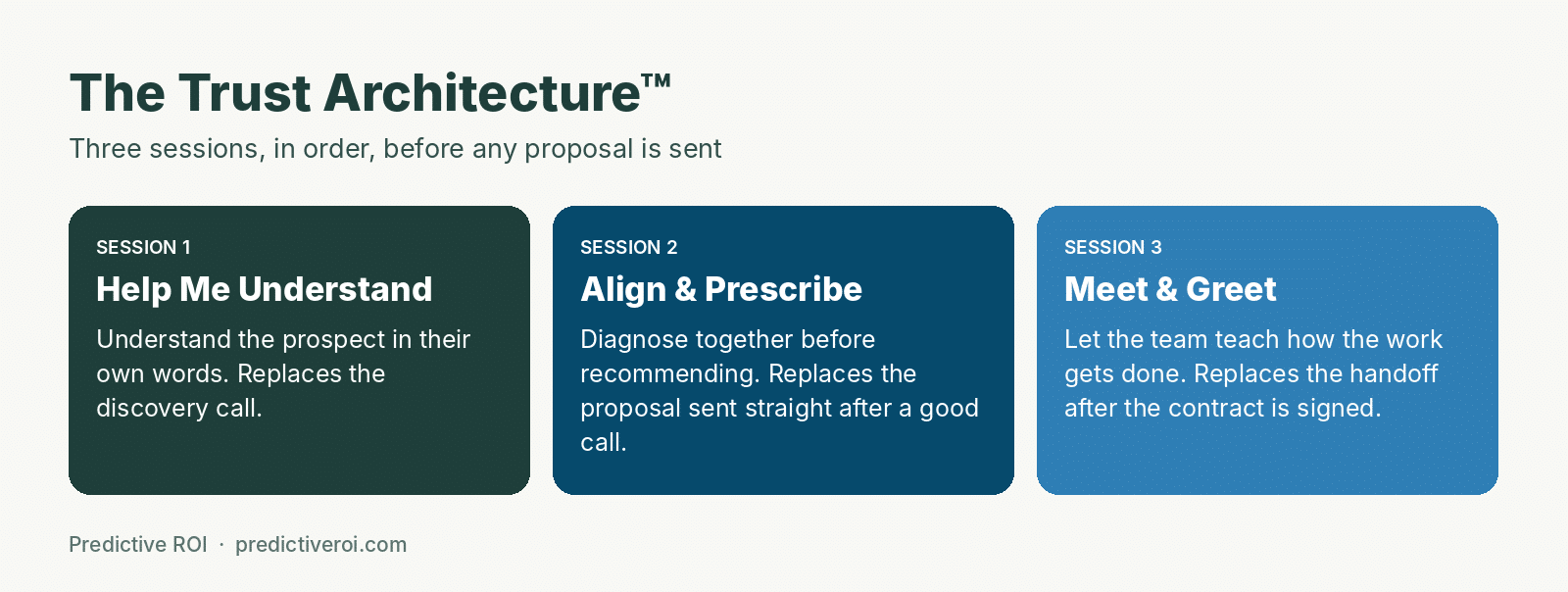
Quick answer. The Trust Architecture™ is Predictive ROI’s three-session sales process for agencies: Help Me Understand, Align & Prescribe and Meet & Greet. In this solocast, Stephen Woessner explains how each session builds trust before a proposal is ever sent, so prospects reach their own decision. The first session listens, the second diagnoses with the prospect, and the third lets the agency’s team teach how the work gets done.
Sell with Authority Podcast, Episode 173 · A solocast with Stephen Woessner, CEO of Predictive ROI · Published August 20, 2025 · Run time 1 hour 9 minutes · Last updated November 27, 2026 · Part of the series on trust in the agency sales process
What Is the Trust Architecture™?
The Trust Architecture™ is Predictive ROI’s three-session sales process, made up of Help Me Understand, Align & Prescribe and Meet & Greet, that moves a right-fit prospect from curiosity to yes without pitching or pressure. Stephen Woessner describes it as the meeting cadence Predictive ROI uses in its own business development and recommends agencies install in theirs. Each session has one job.
Why Do Agency Sales Conversations Stall?
Stephen Woessner’s answer is distrust. He argues that when a prospect goes quiet after a strong call, or a warm lead cools the moment a proposal arrives, the cause is rarely the pipeline, the close or the script. Prospects have sat through discovery calls that turned into sales pitches. In his words, they have “all been down that road before”: 30 minutes of polite interrogation, followed by a generic PDF 48 hours later.
The wider data points the same way. The 2025 Edelman Trust Barometer found that 68% of respondents fear that business leaders lie. Stephen Woessner’s response is to change the structure of the sales process, and he calls that structure an architecture.
“It’s the difference between qualifying a lead… and earning someone’s trust.”
How Do the Three Sessions Build Trust Before a Proposal?
Each session does one thing the next session depends on. Stephen Woessner walks through all three, with an example from Predictive ROI’s own sales conversations for each.
1. Help Me Understand Replaces the Discovery Call
A Help Me Understand session asks five questions and then listens:
- Who do you help?
- What problems do you solve?
- How does it work?
- What are your top three priorities between now and the end of the year?
- What could get in the way?
Stephen Woessner says the priorities question does two things at once: it reveals what matters most to the person, and it surfaces urgency, friction and hidden motivations. The seller’s job is then to reflect back what they heard. He describes that reflection as a gift, because it gives the prospect words for a frustration they have been circling for months.
Worked example: “Sally.” Stephen Woessner describes a session with an agency leader he calls Sally. Asked what motivated her to reach out, she talked for ten minutes. Her agency had restructured, was moving away from paid media and into brand, and its revenue peaks and valleys were wearing on the team. Asked for her top three priorities, she said:
“We need to figure out how to monetize the positioning work we do, not just use it as a lead-in to creative. Our people are strong. But we’re not selling their brains, we’re selling outputs. And that’s gotta change.”
“Sally,” an agency leader, as recounted by Stephen Woessner
Predictive ROI’s team reflected it back: the agency was full of senior strategic horsepower, and the market only saw deliverables. Her reply was “Yes. That. That’s exactly it.” Afterward she called it one of the best conversations she had had in years about where her agency really stood. No pitch and no slides were involved.
He also describes the posture behind the questions. Sellers ask permission (“Would it be okay if I ask you a few questions?”) and check their understanding (“Can I reflect something back to you?”).
“We’re not performing empathy. We’re creating emotional safety with structure.”
Go deeper in Episode 176: Help Me Understand.
2. Align & Prescribe Lets the Prospect Make the Diagnosis
Align & Prescribe is a second meeting where the prospect diagnoses their own agency before any recommendation is made. Stephen Woessner says it is the session agencies are most tempted to skip, moving straight from a great conversation to “here’s a PDF, just sign here.” Predictive ROI uses the Focus Finder™, in which the prospect scores nine dimensions as Red (pain), Amber (weakness), Yellow (strength) or Green (superpower):
- Niche clarity
- Methodology
- Predictable pipeline
- Trust at scale
- Data collection
- High-probability prospects
- Value ladder
- Baselines and patterns
- Optimized sales process
Worked example: “Agency Awesome.” Asked to score his inbound pipeline, the founder of an agency Stephen Woessner calls Agency Awesome answered:
“Probably amber, bordering on red. We’ve relied heavily on referrals and relationships, which is great, but it’s not a system. We’re visible, but we’re not top of mind when decisions are made.”
Founder of “Agency Awesome,” as recounted by Stephen Woessner
About 25 minutes in, the prospect is asked whether they notice any patterns in the Reds and Ambers. The founder saw that most of the friction sat at the front of the funnel: positioning, pipeline and sales process. Stephen Woessner calls that the moment the problem becomes visible, because the prospect has named it. Only then does the seller offer insight, and by asking permission first.
He also explains why this needs its own meeting: combining discovery and diagnosis is like trying to measure and remodel a house in the same visit.
“If your prospect doesn’t feel the gap, they won’t value the bridge.”
Go deeper in Episode 182: Align & Prescribe.
Note: Predictive ROI has updated the Focus Finder™ since this episode aired. The current version follows the nine strategies of the In-Demand Agency Methodology™.
3. Meet & Greet Lets the Team Teach Before the Proposal
A Meet & Greet is a third session, held before the proposal is delivered, where the agency’s team teaches the prospect how the work gets done. Most agencies introduce the team after the contract is signed. Stephen Woessner calls the result “handoff whiplash”: the client trusted the founder, bought into the vision and now faces a brand new relationship. In a Meet & Greet:
- Team members get a focused 10 to 15 minutes each to walk through their playbooks.
- They teach. They do not sell.
- There is no capabilities deck and no recap of the earlier conversations.
Worked example. In the Meet & Greet with Agency Awesome, Hannah Roth of Predictive ROI explained how she builds outreach from behavior that already exists, such as who is clicking and engaging, and not from job titles alone. Libby Stinson of Predictive ROI showed how she maps people two or three degrees removed who are already paying attention. The founder’s reaction: “This feels engineered, not improvised.” One of his executives added that the team had been chasing leads that looked right on paper and ignoring the ones already warming up.
For founders who worry their team is not comfortable in sales meetings, Stephen Woessner’s answer is short: “They’re not selling. They’re teaching.”
“When your team teaches instead of selling, your prospect stops evaluating… and starts imagining.”
What Changes When an Agency Builds Its Own Trust Architecture?
Stephen Woessner lists five changes Predictive ROI has seen:
- Prospects show up more prepared, because they feel safe.
- Sales cycles shorten, because clarity replaces convincing.
- Proposals get approved faster, because the decision already feels made.
- The team feels more ownership, because they are part of the process early.
- Client relationships start stronger, because trust was earned before day one.
“You don’t need more hustle. You need a biz dev process rooted in trust.”
What You Will Learn in This Episode
- Why distrust, and not pipeline or closing skill, stalls agency sales conversations
- The five questions in a Help Me Understand session
- How the Focus Finder™ lets a prospect diagnose their own agency by color
- Why the team should meet the prospect before the proposal, and what they should teach
- Three small shifts an agency can make this week
Put the Episode Into Practice
Stephen Woessner’s advice is to start with one shift:
- Turn your next discovery call into a Help Me Understand conversation.
- Add three diagnostic questions to your next strategy call.
- Bring one team member into your next sales call and let them teach for five minutes.
Key Terms From This Episode
- Trust Architecture™
- The Trust Architecture™ is Predictive ROI’s three-session sales process, made up of Help Me Understand, Align & Prescribe and Meet & Greet, that moves a right-fit prospect from curiosity to yes without pitching or pressure.
- Help Me Understand
- A Help Me Understand conversation is Predictive ROI’s replacement for the discovery call. Its only job is to understand what is happening in an agency, in the agency’s own words, and nothing gets prescribed.
- Align & Prescribe
- Align & Prescribe is the second conversation in the Trust Architecture™, where the agency and the prospect confirm the diagnosis together using the Focus Finder™ before any recommendation is made.
- Meet & Greet
- Meet & Greet is the third conversation in the Trust Architecture™, held before the proposal is delivered, where the agency’s team teaches the prospect how the work gets done.
- Focus Finder™
- The Focus Finder™ is a diagnostic an agency uses on first calls in which the prospect scores their own situation, so the prospect helps make the diagnosis instead of hearing a pitch.
Frequently Asked Questions
What is the Trust Architecture™?
The Trust Architecture™ is Predictive ROI’s three-session sales process, made up of Help Me Understand, Align & Prescribe and Meet & Greet, that moves a right-fit prospect from curiosity to yes without pitching or pressure.
What are the three sessions in the Trust Architecture™?
Help Me Understand, Align & Prescribe and Meet & Greet. The first listens, the second diagnoses with the prospect, and the third lets the agency’s team teach how the work gets done. A proposal follows only after all three.
How is a Help Me Understand session different from a discovery call?
A discovery call usually asks questions that line up with the agency’s services. A Help Me Understand session asks five open questions about the prospect’s business and priorities, and nothing is sold.
Can Help Me Understand and Align & Prescribe be combined into one meeting?
Stephen Woessner advises against it. He compares it to trying to measure and remodel a house in the same visit. Giving the prospect room to reflect between the two sessions makes the eventual recommendation more precise.
When should a prospect meet the agency’s team?
Before the proposal is delivered. In the Trust Architecture™, the Meet & Greet happens while the prospect is still deciding, so trust transfers from the founder to the people who will lead the work.
What if an agency’s team is not comfortable in sales meetings?
In a Meet & Greet the team is teaching, not selling. Stephen Woessner recommends giving each person a framework and 10 to 15 minutes to explain the why behind their work.
Does an agency need the Focus Finder™ to run Align & Prescribe?
No. Stephen Woessner suggests using a tool like the Focus Finder™ or a structured set of categories, as long as the prospect does the scoring.
Where should an agency start?
With one shift. Stephen Woessner suggests turning the next discovery call into a Help Me Understand conversation, adding three diagnostic questions to the next strategy call, or letting one team member teach for five minutes in the next sales call.
Continue the Series
- Episode 176: Help Me Understand, the First Brick in the Trust Architecture™. The full run of show for the first session.
- Episode 182: Align & Prescribe, the Second Brick in the Trust Architecture™. How to build and use a Focus Finder™.
- Episode 189: The Research Behind Building Trust Faster, with Susan Baier and Hannah Roth. Why buyers start from distrust.
- Episode 196: From Authority to Demand. How trust turns into buyer action.
Research Notes and Sources
- Edelman Trust Barometer, 2025. 68% of respondents fear that business leaders lie. Edelman, 2025 Trust Barometer.
- Client examples. “Sally” and “Agency Awesome” are anonymized accounts of Predictive ROI sales conversations, told by Stephen Woessner in the episode. Their quotations appear as he recounted them.
- The results list. The five changes are Predictive ROI’s own observations from its work with agencies. They are not survey findings.
- The Focus Finder™. The nine dimensions listed here are the version taught in August 2025. Predictive ROI has since updated the tool.
- Script and audio. The text below is Stephen Woessner’s script, edited lightly. Where the script and the recording differ, the audio is the authoritative version.
Resources
- Predictive ROI’s Resource Library, including the book Sell with Authority
- How to Fill Your Sales Pipeline, our free Facebook group
- A copy of the Focus Finder™: email [email protected]
Your Right Next Step
If your agency wants to install its own Trust Architecture™, the first step is a Help Me Understand conversation with our team. Nothing gets prescribed. Our only job is to understand what is happening in your agency, in your words. Reach out here and we’ll compare calendars.
Onward with gusto!
About Stephen Woessner
Stephen Woessner is CEO of Predictive ROI, host of The In-Demand Agency Podcast and co-author of Sell with Authority. Meet the Predictive ROI team or connect with Stephen on LinkedIn.
This is Stephen Woessner’s script for the episode, edited lightly for readability. The audio remains the authoritative version.
Welcome to the Sell with Authority Podcast — I’m Stephen Woessner, CEO of Predictive ROI — and my team and I — we created this podcast specifically for you.
If you’re an agency owner looking to sell more of what you do — then you’re in the right place.
Today’s episode is a solocast.
No guest — it’s just you and me — exploring a topic with real depth…so we can get every strategy, every nuance, and every step fully dialed in.
But first — let me set the stage for our time together.
What if biz dev for your agency didn’t feel like chasing…
…didn’t feel like pitching…
…and didn’t feel like trying to convince someone to say yes?
What if — at its best — when it was running smoothly — biz dev was actually a process of building so much trust…
…that your prospects convinced themselves?
That’s what we’re diving into today.
Because the challenge we’re going to unpack?
– It’s not a pipeline issue.
– It’s not a closing issue.
– It’s not a “we need better sales scripts” issue.
It’s a trust issue.
Actually — it’s worse than that.
We don’t just have a trust gap in our industry — we actively have distrust in the market.
And I’m not being dramatic.
The data backs it up.
According to the 2025 Edelman Trust Barometer…
68% of respondents fear that business leaders lie.
– Fear of overpromising.
– Fear of underdelivering.
– Fear of wasting time — again.
Sound familiar?
If you’ve ever had a prospect ghost you after what felt like a great call…
If a warm lead went cold the moment a proposal hit their inbox…
If referrals are slowing and inbound is inconsistent…
It’s not that you’re doing anything wrong.
It’s that the presence of “distrust” is changing the game.
So in today’s solocast — I’m going to show you how to fix that.
Not with tactics.
Not with pitch decks.
But with architecture.
Within the walls of Predictive ROI — we’ve started calling this our Trust Architecture — and it’s the exact 3-part meeting cadence we use to help prospective clients move from curiosity to YES… without ever selling.
I’m going to do my best to help you walk away with a blueprint, playbook, or framework you can install inside your own agency’s biz dev process.
And if you have questions along the way — you can always drop me a line at [email protected].
Okay — let’s dive in by taking a look at the first of three pillars in our Trust Architecture.
We call the first one the “Help Me Understand” session.
Agencies often call this a discovery call, or a free consultation, or some sort of assessment.
But candidly — when your prospects hear discovery or consultation — they know you’re asking them to schedule a sales pitch or capabilities presentation.
Your prospects have all been down that road before — 30 minutes of polite interrogation, followed by a generic PDF 48 hours later.
I know that I’m generalizing here — and perhaps your process is different — but typically what we see is that those sessions are not true “Discovery” and instead it’s a sales trap wrapped in data collection.
At Predictive — we flipped it and we recommend that all of our clients flip it, too, inside their biz dev process.
We call our first meeting what it really is: Help Me Understand.
This isn’t about what we sell.
It’s about why any of it would even matter.
It’s the difference between qualifying a lead… and earning someone’s trust.
Here are the five key questions we ask inside the Help Me Understand framework:
1. Who do you help?
2. What problems do you solve?
3. How does it work?
4. What are your top 3 priorities between now and the end of the year?
5. What could get in the way?
That’s it.
Five questions.
Simple, structured, and HOLY BANANAS — it sets the tone for a super productive discussion.
Why?
Because we don’t interrogate.
We listen.
We create space for our prospective client to reflect out loud — and often, for the first time, to share what’s been weighing on them for a while.
Take this example from a recent session with an agency leader — we’ll call her “Sally.”
Within the first 5 minutes, our team asks, “What motivated you to reach out?”
Sally paused.
Then she said:
“Probably circumstance more than anything. I can give you a really brief on where we’re at…”
Then — for the next ten minutes — Sally shared, and shared, and shared.
Her agency had just restructured their org chart.
They were moving away from paid media and repositioning into brand.
They had strong clients — but revenue peaks and valleys were wearing on the team.
She wanted to sell differently — smarter, more predictably — but didn’t know where to begin.
No pitch. No slides.
Just space for Sally.
She later said to us…
“This was honestly one of the best conversations I’ve had in years about where our agency’s really at. I didn’t realize how much was in my head until I had the chance to just say it out loud.”
That is an indicator that we did our job. Not to sell. But to build trust.
Here’s what makes the Help Me Understand session so powerful.
Agencies without an effective biz dev process ask questions that only line up with their service offering.
If that sounds like you – please stop doing that.
Instead — I want you to ask your next prospect questions that help you understand the story beneath their strategy.
Even more simply – use the five questions from our Help Me Understand framework.
If you do that — your prospective client will not only answer your questions with data.
Your prospect will tell you all about the weight she’s been carrying.
I promise you — if you do this right — the “Help Me Understand” sessions you conduct will become your prospect’s release valve.
We always make sure to ask this one question…
“What are your top 3 priorities between now and the end of the year?”
This question does two things instantly:
It reveals what matters most — not to the agency, per se, but to the person.
It surfaces urgency, friction, and hidden motivations.
Here’s what Sally said when we asked her:
“We need to figure out how to monetize the positioning work we do — not just use it as a lead-in to creative. Our people are strong. But we’re not selling their brains — we’re selling outputs. And that’s gotta change.”
Um, what?
Huge golden nugget.
She didn’t need a sales pitch. She needed someone to finally peel back the layers and see the same tension she’s been feeling.
So our team reflected it back to her.
We asked, “So — you’re saying your agency’s full of senior-level strategic horsepower — but the market only sees deliverables. Is that fair?”
Sally nodded.
And that’s when she said:
“Yes. That. That’s exactly it.”
So, friends — if you want to build trust — reflect the clarity around what you’ve been hearing back to your prospect.
Not as a trick — not as persuasion — but as a gift.
Give them words for the frustration they’ve been circling for months.
That’s how trust is earned — and distrust is blown out of the water.
Let me pause here for a second, friends.
If you’re listening to this while driving to the office — wondering why discovery calls feel flat, or why your last few proposals haven’t converted — I promise you:
It’s likely not because your slide deck is off.
It’s likely because your first meeting is missing the one thing that matters most:
A structured space for your prospects to feel heard.
They don’t need a funnel walkthrough.
They need you to hear and see them.
And if you give it to them — not as bait, but as value — they’ll lean in.
Not because you convinced them…
But because you understood them.
Let’s also talk about tone for a second.
“Help Me Understand” isn’t just the name of the session.
It’s the posture we take.
When our team is asking questions — we say things like:
“Would it be okay if I ask you a few questions to better understand how you’ve been thinking about this?”
“Can I reflect something back to you to make sure I’m on the same page?”
“What’s felt hardest about that shift — for you personally?”
“Are there blind spots you suspect might be slowing things down?”
We’re not performing empathy.
We’re creating emotional safety with structure.
And when your prospects genuinely feel that from you?
You help them relax.
You help them open up.
And then you move from “one of many agencies she’s evaluating” — to… you’re at the top of what is now a very short list.
And instead of trying to “wow” your prospect with polish — you’ve created a structured, predictable way to invite her to reflect.
That’s what this first session is.
It’s the foundation for everything else that follows.
Because when someone feels seen and safe — they lean in.
And that is how you start building your Trust Architecture.
Let’s move to the second pillar — we call it Align & Prescribe.
And candidly — this will be a very tempting pillar for you to skip.
The typical agency wants to move immediately from “great conversation” to “here’s a PDF – just sign here” — with no real bridge between the prospect’s curiosity and commitment.
The agency gets so excited about the possibility of winning a new client that they miss the opportunity to help their prospect see the gap that exists between where they are — and where they could be.
When that happens…
Even after a strong discovery call, the prospect ghosts.
Or worse — they say, “We’re going to hold off for now.”
Why?
Because the prospect and the agency weren’t aligned.
The agency didn’t diagnose the client.
They pitched the client.
At Predictive — we don’t pitch.
We Prescribe — and only after we’ve Aligned. And we want you to take this process and do the same thing with your prospects.
Here’s how we do it:
We walk each of our prospective clients through what we call The Focus Finder — a diagnostic tool that helps our prospective client self-assess across nine critical dimensions of their agency:
1.Niche clarity
2.Methodology
3.Predictable pipeline
4.Trust at scale
5.Data collection
6.High probability prospects
7.Value ladder
8.Baselines and patterns
9.Optimized sales process For each one — we ask:
“Where are you today? Red, Amber, Yellow, or Green?”
Red = Pain Amber = Weakness Yellow = Strength Green = Superpower There’s no shame. No spin. No “gotcha.”
Just honest reflection — guided by structure.
Let me show you what this looks like in practice.
A few weeks ago, we sat down for an Align & Prescribe session with a prospective client — let’s call them “Agency Awesome.”
We asked the founder:
“Where would you score Agency Awesome’s inbound pipeline?”
He paused.
Then said:
“Probably amber, bordering on red. We’ve relied heavily on referrals and relationships — which is great — but it’s not a system. We’re visible, but we’re not top of mind when decisions are made.”
Boom. That’s clarity.
Not because we told him something new — but because he named it.
Later in the session, we walked through “Value Ladder”
and how to build out a suite of streamlined services that are all linked together and are strategically priced.
He said:
“We’ve got strong capabilities — but it’s bundled together in a way that’s hard to sell. Our entry point is fuzzy, and it’s hard to explain in under 30 seconds.”
Again — no pitch.
Just guided reflection using The Focus Finder — and now he’s literally saying what his obstacles are — with specificity and ownership.
Here’s the moment that always lands hard:
About 25 minutes in — we pause and ask:
“Do you notice any patterns in the Reds and Ambers?”
Without fail — they do.
With Agency Awesome, he said:
“It’s weird — our team is incredibly talented… but most of our friction is at the front of the funnel. Positioning, pipeline, sales process — that’s where we’re soft. And it’s holding back the rest.”
That, friends, is THE moment.
Because now — the pain is visible.
It’s not just intuition or a gut feeling. It’s been diagnosed.
Not by us — by your prospective client.
Okay, friends — let’s take a second to think back…
If you’ve ever sent a proposal and thought, “Why didn’t they move forward? That conversation felt amazing…”
Chances are — you skipped the Align & Prescribe step.
You moved from rapport to recommendation — without walking your prospect through seeing what’s broken — and what could be on the other side as a result of your help.
Because here’s the reality:
If your prospect doesn’t feel the gap — they won’t value the bridge.
You may have nailed the pitch.
But without alignment — it falls flat.
Let’s talk more about prescription — because this is where you may be tempted to flex your “expertise.”
But please don’t.
Don’t try to impress.
Instead — I want you to resist the urge and take time to further clarify.
Here at Predictive — our team will say things like:
“You mentioned earlier your inbound pipeline is amber — but that referrals are strong. That tells us the relationships are there — but not the content engine. Sound fair?”
“It sounds like your offer structure is solid once you’re in the room — but there’s friction getting in the room in the first place. Can I offer a few thoughts on why that might be?”
“You’ve got a superpower in thought leadership — but it’s not mapped to your lead gen. That disconnect is probably why the pipeline feels lumpy. Should we dig into that?”
We ask permission.
We stay anchored in what they shared with us.
And then we offer insight — not a proposal.
I’m going to go back to Agency Awesome for a moment.
After we diagnosed The Focus Finder together, here’s what the founder said:
“This is honestly the first time I’ve seen the whole landscape at once. Usually we’re so focused on the next project, we don’t step back and see how all of this connects.”
That friends — is exactly why the Align & Prescribe session exists.
Not to sell.
But to clarify and further build the scaffolding in our Trust Architecture.
And when it’s done well — the proposal or agreement isn’t a surprise.
It’s a logical next step.
Let’s talk mechanics for a moment.
You might be wondering, “Do I really need a whole second meeting for this? Can’t I just roll this into the first call?”
Fair question.
But here’s the thing:
Trying to combine “discovery” and “diagnosis” into one meeting is like trying to measure and remodel a house in the same visit.
I encourage you to slow down.
Give your prospect some breathing room.
The more space they have to reflect — the more precise your eventual recommendation will be.
And when the diagnosis is clear and collaborative, the proposal you provide feels less like a pitch — and more like a solution they helped shape.
I want to make one more point here before we move on.
When we walk someone through The Focus Finder, we’re not telling them what’s wrong.
We’re giving them a language they can own by describing the friction that’s likely been lingering under the surface.
When you do that — your prospect feels smarter…not smaller.
They feel equipped — not pressured.
And that’s what moves people.
Because when a prospective client sees their business with fresh clarity — and they attribute that clarity to you — you’ve just earned authority without selling a thing.
Here are three points I want you to take away from this:
1.Don’t skip the diagnosis.
2.Don’t hide from the hard truths.
3.And don’t try to “wow” them — help them see themselves.
That’s what Align & Prescribe is all about.
Okay – if you’d like a copy of our Focus Finder – just drop me an email at [email protected] and I’d be happy to send you the PDF so you can use it as a guide when creating your own.
Let’s bring it home with the final pillar in your Trust Architecture — the one that cements confidence before an agreement is provided.
We call this the Meet & Greet session.
Candidly — this is a part of the sales process that’s often underutilized, or worse — treated as a handoff formality, or part of onboarding.
We’ve worked alongside hundreds of agencies over the last 15 years — and it’s common to see this step either skipped entirely or handled in a way that unintentionally creates doubt, not confidence.
Here’s what it often looks like:
“Hey — thanks for signing! Now meet Sarah, your new account lead. She’ll be your main point of contact moving forward.”
The prospect — who trusted the founder, who loved the pitch, and bought into the vision — is now faced with a brand new relationship to navigate.
What happens next?
Handoff whiplash.
The trust that was built early in the process gets strained right when the client should be feeling the most reassured.
The excitement they had about getting started is replaced with a cautious “let’s see how this goes.”
We believe this is a huge missed opportunity.
So here at Predictive — we flip it.
We don’t wait until a prospect says YES.
We bring our team in before the proposal is even delivered — and not just to say hello.
We bring them in to teach.
Because in that teaching moment — something powerful happens:
The prospect doesn’t just meet your team…
They begin to trust your process.
They don’t just hear how smart you are.
They see it, feel it, and start to imagine themselves inside your System.
Here’s how we do it.
We invite two of our senior team members to the third session:
Hannah Roth — our director of strategy and mad scientist She leads with a breakdown of The Biz-Dev Playbook — the framework she uses to engineer outbound campaigns that actually generate conversations.
But this isn’t theory.
It’s grounded in data — behavioral signals, response triggers, real-time testing, and analysis of tens of thousands of data points.
In the recent Meet & Greet with Agency Awesome — here’s how Hannah opened:
“I start by looking at where behavior already exists. Not just titles or job functions — but what people are actually doing. Who’s clicking? Who’s engaging? Who’s showing early signs of curiosity that we can nurture?”
Then she layered in examples:
How Directors behave differently from VPs Which sequences yield higher engagement What subject lines trigger attention in cold outreach And — most importantly — how The System learns and evolves over time Hannah didn’t oversell it.
Hannah simply taught what she knows.
And the founder of Agency Awesome — who had heard all kinds of sales promises over the years — paused and said:
“I’ve never seen outbound explained like this. This feels engineered — not improvised.”
That’s trust — built in real time.
Then Libby Stinson on our team steps in. Libby is our forensics expert.
She teaches The Prospect Playbook — her method for identifying and mapping the people inside your prospect’s universe who are already leaning in… even if you can’t see it yet.
She explains:
How she scores and prioritizes relationships How she interprets digital breadcrumbs and social proximity How she builds what we call relational gravity In that same session with Agency Awesome, Libby walked the team through a real-time demo:
“We look for second-degree signals — the people who are two or three degrees removed but already in your orbit.
They’re liking posts. Attending webinars. Mentioned in press releases. Those are warm signals — even if no one’s replied yet.”
She showed how curiosity often hides in the shadows — and how we surface it.
Not with a lead list.
But with a network intelligence map that’s filtered, ranked, and ready.
And the reaction?
One of Agency Awesome’s executives leaned forward and said:
“We’ve been chasing leads that look right on paper… and ignoring the ones who are already warming up. This flips the script.”
That’s what Libby does.
That’s what your team can — and should do — too.
When your team teaches instead of selling — your prospect stops evaluating… and starts imagining.
But let’s say you’re listening to this and thinking:
“Okay, Stephen — my team isn’t comfortable presenting.
They’re not used to being in sales calls.”
I hear you.
But here’s the secret:
They’re not selling. They’re teaching.
Give them a framework.
Let them explain the why behind what they do — not just the deliverables.
We often work with agency teams to help them articulate their zone of genius in a way that feels natural — not rehearsed.
Once they have that structure, they don’t just “present”
better — they connect better.
And when your prospective client sees that?
They stop worrying about buyer’s remorse — and start trusting the people who will actually lead the engagement.
One more thing…
We often find that agency founders fear bringing in their team early because they think:
“What if the prospect doesn’t like them?”
“What if it complicates the sale?”
But here’s what we’ve actually seen happen again and again:
The earlier you include and introduce your team — the more confident your prospect becomes.
Why?
Because it shows this isn’t a one-person operation.
It’s not “The Sarah Jones Show.”
It’s a system.
Run by a team.
Built to last.
And that scales trust beyond you.
More specifically — here’s what we don’t do in a Meet & Greet:
– No capabilities deck
– No recapping the sales conversation
– No “Hi, I’m the account manager and I’ll be your main contact”
Here’s what we do instead:
– Give the team a focused 10–15 minutes to walk through their playbooks
– Let them teach — not sell
– Watch the prospect connect dots on how everything fits together Because at the end of the day — when your prospect sees not just the proposal, but your team — her confidence skyrockets.
And the sale?
It’s not a pitch.
It’s a confirmation.
Just imagine this…
You’re the founder of an agency.
You’ve had two great meetings with a prospect.
And now — in the third session — your strategist walks them through how you map client success.
Your ops lead shows how onboarding runs with precision.
Your media buyer explains how campaigns are optimized in week two — not month two.
No jargon.
No fluff.
Just teaching.
And your prospect?
They’re leaning in because your team just demonstrated how the results are created.
That’s the moment where the decision is already made.
Not because you asked for the sale — but because you didn’t have to — you earned it.
Okay — here’s 3 points I want you to take away from this:
1.Your Meet & Greet isn’t a formality.
2.It’s not a step to “check the box.”
3.It’s your final proof point — before a contract is even sent.
When you let your team teach the process — not just perform it later — your prospect walks away thinking:
“This is different. This is better. This is what we’ve been looking for.”
Okay, friends…let’s start to bring this in for a landing.
What we’ve just walked through isn’t a sales process.
It’s not a funnel.
It’s not a set of “closing tactics.”
It’s an architecture for building trust — a system designed not to pitch — but to partner.
And candidly, that’s what your future clients are craving.
They’ve been burned.
They’re skeptical.
They’re cautious for good reason.
At the onset, they distrust you.
But they’re also still looking.
They’re looking for an agency that doesn’t just claim to understand them — but proves it, before the engagement even begins.
That agency — can be yours, my friends.
Here’s your blueprint.
Three simple sessions. Deeply intentional. Unmistakably different.
Session 1 — Help Me Understand Don’t “run a discovery call.”
Have a Help Me Understand conversation.
Lead with curiosity. Not conversion.
Give your prospect room to reflect — not just react. Ask thoughtful, open-ended questions that invite vulnerability.
And the shift is subtle — but seismic.
They no longer feel interrogated — they feel understood.
And in that moment — they stop resisting.
They start leaning in.
Session 2 — Align & Prescribe This is where you create clarity — without creating pressure.
You’re not pitching. You’re diagnosing.
I encourage you to use a tool like The Focus Finder — or even just a structured set of categories — you help your prospect see where tension lives inside their business.
You walk them through each key pillar — not to point out flaws — but to name the opportunities hiding in plain sight.
And when they see three Amber scores stack up?
They’re not embarrassed — they’re relieved.
Because someone finally gave them the language they’ve been searching for.
Your proposal that follows is not a leap — it’s a logical next step they’ve already begun to expect.
Session 3 — Meet & Greet This is your moment to transfer trust from you to the people who will actually lead the work.
And it’s common for agencies to hesitate here.
You might be thinking:
– “Stephen, what if my team’s not great in front of clients?”
– “What if they can’t explain our process as well as I can?”
– “What if this makes the sale harder, not easier?”
I promise — I get it.
But here’s what we’ve learned after 15 years of watching agencies grow — and stall:
The agencies who trust their team to teach early — are the ones who earn trust faster.
You don’t need your team to sell.
You just need them to share.
Let them walk through the why behind the work they do.
Give them a framework and let them own their zone of genius.
That moment — when your strategist explains their approach, or your ops lead shows how onboarding runs with precision — that’s the moment when the prospect stops shopping.
They’ve found their team. Your team.
Okay — as you think about everything that I’ve shared with you — you might be feeling this pull… but also this pause.
So let’s talk about it.
“But Stephen, this sounds like a lot to implement.”
You’re absolutely right. This is not a light lift — but it’s so worth the effort of doing it.
And you certainly don’t have to build everything overnight.
Start with just one shift.
– Turn your next discovery call into a Help Me Understand conversation.
– Add 3 simple diagnostic questions into your next strategy call.
– Bring one team member into the next sales call and let them teach for five minutes.
Small shifts. Big impact.
And candidly, friends — the fact that you’re even still listening to this solocast tells me you already know the cost of doing it the old way.
– The feast-or-famine pipeline.
– The clients who say yes, but never feel fully committed.
– The exhausting pressure of “always closing.”
You don’t need more hustle.
You need a biz dev process rooted in trust.
Here’s what we’ve seen happen when agencies build their own Trust Architecture:
1.Prospects show up more prepared — because they feel safe
2.Sales cycles shorten — because clarity replaces convincing
3.Proposals get approved faster — because the decision already feels made
4.The team feels more ownership — because they’re part of the process early
5.Client relationships start stronger — because trust was earned before Day 1 And perhaps most important?
You stop feeling like a salesperson — and instead — you start feeling like what you really are:
A guide.
A teacher.
A partner in the transformation your clients are seeking.
And friends — if you’ve been nodding through this episode…
If any of this has felt uncomfortably familiar…
Or if you’ve thought:
“We kind of already do this — just not on purpose…”
That’s your cue.
Because even if your agency is already strong…
Even if your reputation is solid…
Even if your team is sharp…
You know there’s another level out there.
A level where your process earns trust automatically.
Where your sales conversations spark momentum — not resistance.
Where your pipeline flows — because your authority precedes you.
You can build that.
Starting now.
Okay — and lastly — if You’d Like a Peek Behind the Curtain…
We’re here.
No pitch.
No pressure.
No “sales call.”
Just a candid conversation — agency to agency — about how we’ve built this for ourselves and how we help other agencies install it inside their business.
If you want to see what The System looks like behind the curtain — just say the word.
So here’s what I want to leave you with, friends.
You don’t have to chase.
You don’t have to convince.
You don’t have to overpromise or out-hustle.
You just need a process — one that reflects who you already are:
– Thoughtful.
– Intentional.
– Credible.
– Trusted.
And once your sales process starts to match your delivery…
Everything changes.
Okay, everyone — I hope that was helpful.
And before we go — I want to say thank you. We all have the same 86,400 seconds in a day and I’m grateful for your time.
I wish you the best of success in building your own Trust Architecture. I’ll be back next week – but until then — onward with gusto!
The Sell with Authority Podcast is for agency owners and leaders who want to grow a thriving, profitable agency that can weather the constant change that seems to be our world’s reality.