Help Me Understand: The First Brick in the Trust Architecture™, with Stephen Woessner
Episode 176

Watch the 23-minute video, or listen to the full episode in the player above.
Quick answer. A Help Me Understand session is a 60-minute first conversation that replaces the agency discovery call. The agency asks five questions, listens for about 70 percent of the time, mirrors back what it heard in the prospect’s own words and previews the next step. In this solocast, Stephen Woessner shares the five questions, five lessons and the full run of show Predictive ROI uses.
Sell with Authority Podcast, Episode 176 · A solocast with Stephen Woessner, CEO of Predictive ROI · Published September 10, 2025 · Run time 50 minutes · Last updated November 27, 2026 · Part of the series on trust in the agency sales process
What Is a Help Me Understand Session?
A Help Me Understand conversation is Predictive ROI’s replacement for the discovery call. Its only job is to understand what is happening in an agency, in the agency’s own words, and nothing gets prescribed. Stephen Woessner calls it the first brick in the Trust Architecture™, Predictive ROI’s three-session sales process. The name is deliberate. The session is not called discovery, qualifying or a capabilities overview, because the seller’s posture is “I want to understand what matters most to you.”
Why Does the First Sales Conversation Need to Change?
Stephen Woessner’s answer is that prospects now start from distrust. He hears the same things from agency owners: the pipeline feels fragile, opportunities dry up unless the founder is in the room, and new tools and hires have not produced traction. His message to them is direct: “It’s not you. It’s distrust.” The 2025 Edelman Trust Barometer found that 68% of respondents fear that business leaders lie.
Pitching harder does not fix that. A first meeting built around the prospect does. The seller slows down, asks five questions and listens deeply. Done well, Stephen Woessner says, the seller stops looking like a vendor trying to win the work and starts looking like a guide.
“The antidote is trust.”
What Are the Five Help Me Understand Questions?
Stephen Woessner says the five questions look simple, and each one is built to open a door. Here is what each question asks and what the seller listens for.
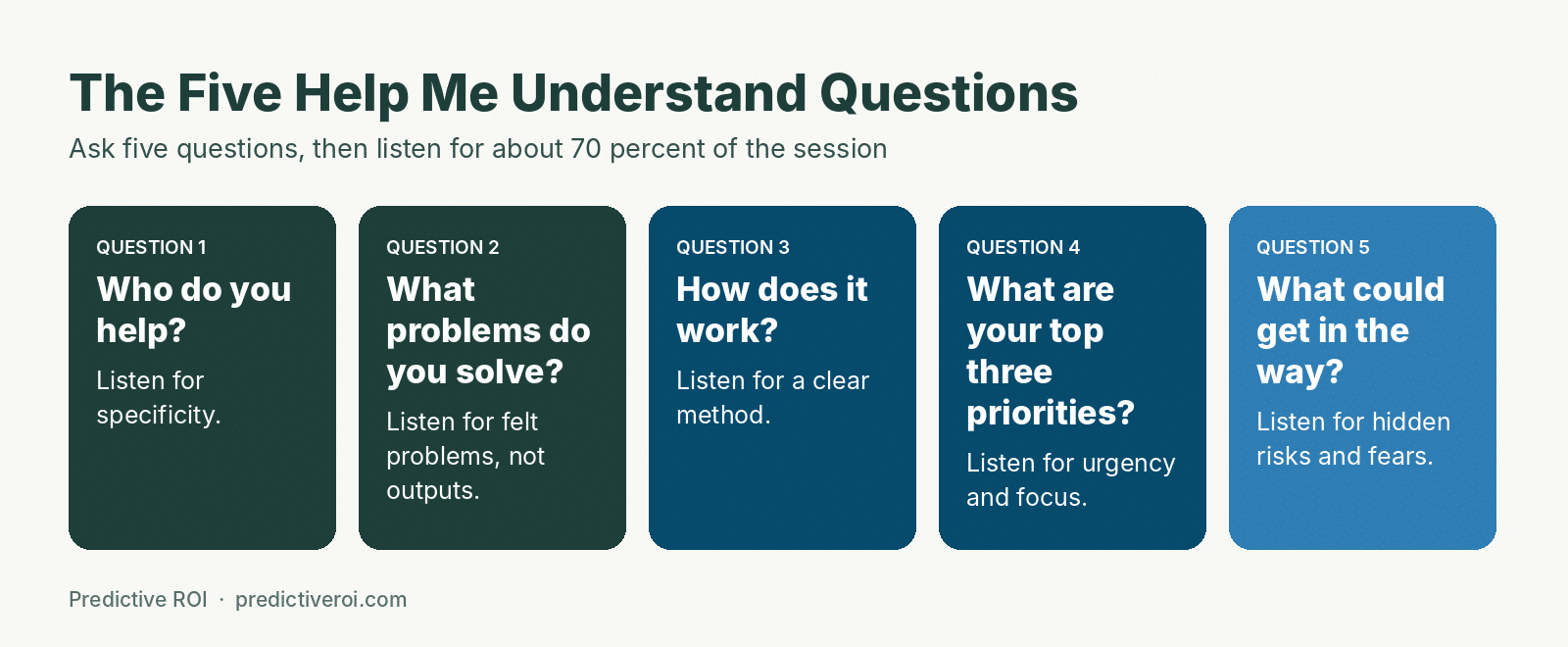
1. Who Do You Help?
The first question sets the tone, and the seller listens for specificity. Does the prospect name a well-defined audience, or describe “anyone with a budget”? A stumble here suggests the prospect is only half-committed to a niche. Stephen Woessner recommends one follow-up: “Who says no to you most often, and why?” Together the two questions show who is not a fit and where the messaging may be falling flat.
Listen for specificity.
2. What Problems Do You Solve?
The second question moves from who the prospect serves to why those clients need them. The seller listens for language. An answer like “We provide integrated marketing solutions” describes an output. Real business issues sound like “Our pipeline is unpredictable” or “We can’t prove ROI.” The seller does not correct the prospect. The seller listens and mirrors it back later.
“When they feel their own pain reflected back, trust accelerates.”
3. How Does It Work?
The third question diagnoses whether the prospect has a process or methodology at all. A clear, step-by-step answer means they have productized their expertise. “It depends, everything we do is custom” is a signal. Stephen Woessner’s discipline for the seller: resist the urge to explain your own method in response. Take notes and reflect later.
“Fog creates uncertainty and uncertainty kills sales.”
4. What Are Your Top Three Priorities for the Next 12 to 18 Months?
The fourth question moves the conversation from abstract to tangible and forces prioritization. If the prospect cannot name three, that tells the seller something. If they name ten, that tells the seller something too. Sometimes it surfaces what the prospect has been avoiding. One agency leader told Predictive ROI’s team:
“We need to grow revenue by $2M or we’ll have to downsize the team.”
An agency leader in a Help Me Understand session, as recounted by Stephen Woessner
“That’s not just a goal. That’s a stake in the ground.”
5. What Could Get in the Way?
Stephen Woessner calls the fifth question the game-changer. It signals that the seller is not naive, and it invites the risks, bottlenecks and fears that usually stay hidden. Often it is the first time the prospect has said them aloud to anyone outside the team.
“Honestly, it’s me. I’m the biggest bottleneck. I don’t want to let go of control, but I know I’m holding us back.”
An agency CEO in a Help Me Understand session, as recounted by Stephen Woessner
He would not have shared that during a pitch. Stephen Woessner says the five questions work for two reasons: they place the prospect at the center of their own story, and they create emotional safety.
“I trust you enough to let you in.”
What Does a Help Me Understand Session Sound Like? The Story of “Sally”
Stephen Woessner tells the story of an agency leader he calls Sally. From the outside her agency looked successful, with a decent roster of clients, a strong reputation and years of experience. Inside, the pipeline was dry, and every new client hinged on whether she or her partner was personally involved. Sally shared none of that at the start of the call. It surfaced as the session unfolded, and she said:
“I’ve yet to find a solution that consistently produces net new clients that aren’t brought in by me or my partner.”
“Sally,” an agency leader, as recounted by Stephen Woessner
Stephen Woessner points out how rare that level of candor is in a first meeting. Predictive ROI’s team had not dazzled her with a deck or a list of awards. They asked open-ended questions, did not rush to fill the silence and did not jump to how Predictive ROI could fix it. By the end, Sally was confiding.
What Makes Help Me Understand More Than a Discovery Call?
Five lessons sit underneath the five questions, in Stephen Woessner’s telling:
- Redefine success. A prospect liking you is not the goal. The goal is that they experience the structure and think, “If they run sales this well, they’ll probably run my work this well too.”
- De-commoditize your agency. Without structure, every first meeting feels the same: small talk, a few broad questions and a slide deck. A guided process shows the agency has done this before.
- Create safety through predictability. Prospects guard themselves when they feel they are walking into a black box. Tell them what happens next.
- Highlight what’s scalable. A process can be taught, so the weight of new business no longer rests only on the founder. Stephen Woessner adds that prospects prefer to see depth in the team.
- Bridge the architecture. Connect this session to Align & Prescribe and then Meet & Greet, so the prospect knows they are on a guided path.
“The process itself is the proof.”
How Do You Run a Help Me Understand Session?
Stephen Woessner shares the run of show in five steps.
- Before the call: prepare with intention. No slides. Skim their website and note the positioning. Check LinkedIn for their headline, recent posts and tone, so your follow-up questions feel personal.
- Open: set expectations. Say there is no presentation and no pitch, that you will ask a few questions and mostly listen, and that what they share is confidential. Then ask, “Sound good?” Book 60 minutes and say why.
- During: ask the five questions. Talk no more than 30 percent of the time. Do not rescue the prospect when they stumble. Take verbatim notes, and record the session if you can.
- Close: summarize and preview. Repeat their top three priorities and biggest obstacle in their language, ask whether you understood correctly, then be quiet. After they confirm or correct you, preview the Align & Prescribe session.
- After: send a recap within 24 hours. Three bullets, 120 words at most: their priorities in their words, the obstacles that surfaced and the next step on the calendar.
The opening script. Stephen Woessner suggests saying something like this in the first few minutes:
“Thanks again for carving out 60-minutes from your compressed schedule. Just to set the stage, this isn’t a presentation. No slides. No pitch. Instead, I’ll ask a few questions to better understand your goals, priorities, and where friction may be showing up. And then I’ll mostly listen. Everything you share is confidential. Sound good?”
Stephen Woessner’s suggested opening for a Help Me Understand session
Three follow-ups that peel back a layer:
- “Can you share a recent moment when that showed up?”
- “What would meaningful progress look like in 90 days?”
- “What’s at risk if this doesn’t change?”
Prospects have told Predictive ROI, “That recap email alone was worth the call.”
“Discomfort is diagnostic.”
What You Will Learn in This Episode
- Why distrust is the barrier between agencies and new business
- The five questions, and what to listen for in each answer
- The five lessons that lift the session above a discovery call
- A five-step run of show, from preparation to the recap email
- How to preview the next session so the prospect knows what to expect
Put the Episode Into Practice
- Book your next first meeting for 60 minutes, and tell the prospect why.
- Close PowerPoint. Open with the no-slides, no-pitch script and ask, “Sound good?”
- Ask the five questions and keep your own talking under 30 percent.
- Summarize their top three priorities in their words and ask if you got it right.
- Send the three-bullet recap within 24 hours.
Key Terms From This Episode
- Help Me Understand
- A Help Me Understand conversation is Predictive ROI’s replacement for the discovery call. Its only job is to understand what is happening in an agency, in the agency’s own words, and nothing gets prescribed.
- Trust Architecture™
- The Trust Architecture™ is Predictive ROI’s three-session sales process, made up of Help Me Understand, Align & Prescribe and Meet & Greet, that moves a right-fit prospect from curiosity to yes without pitching or pressure.
- Align & Prescribe
- Align & Prescribe is the second conversation in the Trust Architecture™, where the agency and the prospect confirm the diagnosis together using the Focus Finder™ before any recommendation is made.
- Focus Finder™
- The Focus Finder™ is a diagnostic an agency uses on first calls in which the prospect scores their own situation, so the prospect helps make the diagnosis instead of hearing a pitch.
- Meet & Greet
- Meet & Greet is the third conversation in the Trust Architecture™, held before the proposal is delivered, where the agency’s team teaches the prospect how the work gets done.
Frequently Asked Questions
What is a Help Me Understand conversation?
A Help Me Understand conversation is Predictive ROI’s replacement for the discovery call. Its only job is to understand what is happening in an agency, in the agency’s own words, and nothing gets prescribed.
What are the five Help Me Understand questions?
Who do you help? What problems do you solve? How does it work? What are your top three priorities for the next 12 to 18 months? What could get in the way? Stephen Woessner says the seller asks these five and then listens.
How long should a Help Me Understand session be?
Sixty minutes. Stephen Woessner says 30 minutes creates rush, and 60 gives the prospect room to feel seen and heard.
How much should the agency talk?
No more than 30 percent of the time. Stephen Woessner says the prospect should be talking for about 70 percent while the agency listens and takes notes.
How is Help Me Understand different from a discovery call?
A discovery call often ends in a pitch or a slide deck. A Help Me Understand session has no slides and no pitch. The agency asks five questions, mirrors back what it heard in the prospect’s words and previews the next session.
What goes in the recap email?
Three bullets in 120 words or fewer, sent within 24 hours: the prospect’s top priorities in their own words, the obstacles that surfaced and the next step on the calendar.
Can someone other than the founder lead the session?
Yes. Stephen Woessner says leading the session does not depend on charisma or founder magic. It is a process, so it can be taught to other members of the team.
What comes after a Help Me Understand session?
Align & Prescribe, the second session in the Trust Architecture™, where the prospect scores their own business with the Focus Finder™ before any recommendation is made.
Continue the Series
- Episode 173: The Trust Architecture™. The overview of all three sessions.
- Episode 182: Align & Prescribe. The second session, and how to build a Focus Finder™.
- Episode 189: The Research Behind Building Trust Faster, with Susan Baier and Hannah Roth. Why buyers start from distrust.
Research Notes and Sources
- Edelman Trust Barometer, 2025. 68% of respondents fear that business leaders lie. 2025 Edelman Trust Barometer.
- Client examples. “Sally,” the agency leader and the agency CEO are anonymized accounts of Predictive ROI sales conversations, told by Stephen Woessner in the episode. Their quotations appear as he recounted them.
- Statistics in the recording. The audio cites several statistics that are not repeated on this page or in the script below, because their sources could not be confirmed.
- Script and audio. The text below is Stephen Woessner’s script, edited lightly. Where the script and the recording differ, the audio is the authoritative version.
Resources
- Predictive ROI’s Resource Library, including the book Sell with Authority
- How to Fill Your Sales Pipeline, our free Facebook group
Your Right Next Step
The fastest way to learn a Help Me Understand conversation is to be in one. Our team will ask you the five questions and reflect back what we hear, in your words. No pitch and no pressure. Reach out here and we’ll compare calendars.
Onward with gusto!
About Stephen Woessner
Stephen Woessner is CEO of Predictive ROI, host of The In-Demand Agency Podcast and co-author of Sell with Authority. Meet the Predictive ROI team or connect with Stephen on LinkedIn.
This is Stephen Woessner’s script for the episode, edited lightly for readability. The audio remains the authoritative version.
Open + Context
Welcome to the Sell with Authority podcast. I’m Stephen Woessner, CEO of Predictive ROI — and today’s episode is a solocast.
No guest — it’s just you and me with the space and time to explore and peel back a topic with some real depth.
My goal for this solocast is to give you something you can apply this week inside your agency.
Not theory.
Not abstraction.
But instead — a step-by-step framework you can use to build trust during every new business conversation from this moment forward.
If you’ve been listening for a while, you know that in Episode 173, I introduced you to what we call The Trust Architecture™ here at Predictive.
I want you to think of Episode 173 as the 30,000-foot view.
Sort of like a sweeping overview of how agencies can flip the script on biz dev.
Instead of pitching, persuading, and pushing, we want you to install a framework that builds so much trust that your prospects begin to convince themselves.
Now — let’s imagine we’re writing a book together.
Think of Episode 173 as Chapter 1 — it provided the broad introduction, the reason The Trust Architecture exists, and a quick look at the three sessions that make up the Architecture.
Today’s solocast is Chapter 2 — and it isn’t about the big picture.
Instead — Chapter 2 is about the very first brick that sets the foundation for the entire architecture.
A framework for a single conversation with one of your prospects that — if you apply it with excellence — sets up every conversation that follows.
That first brick is a conversation we call Help Me Understand.
And in today’s solocast, I’m not just going to share what it is.
I’m going to share the entire playbook. The exact run of show.
The five questions you’ll ask.
And the five big lessons that elevate a Help Me Understand session well beyond a typical “discovery call.”
When you apply this conversation framework with excellence — your prospective client doesn’t just share their story — they feel seen, heard, and understood.
They leave the session thinking, “If this agency runs their sales process this well, imagine how well they’ll run my work.”
That’s the power of Help Me Understand.
And that’s where we’re going today.
Why Help Me Understand Exists
Before we dive into mechanics — let’s pause and I feel that I should share some additional context around why Help Me Understand exists and perhaps why we placed it as the foundational brick in the architecture.
Think about how biz dev has felt over the last year or two.
Heavier. Harder. More unpredictable.
Agency owners tell us all the time:
1. “Our pipeline feels fragile.”
2. “Opportunities dry up unless I’m personally in the room.”
3. “We’ve tried hiring salespeople, but nothing sticks.”
4. “We’ve invested in tools, shiny objects, consultants…
and still no traction.”
After enough trial and error — a question starts to bubble up: “Is it just us? Are we doing something wrong?”
I promise you — it’s not you. It’s distrust.
So if your sales pipeline feels heavier than it did even 12 months ago, you’re not imagining things. It’s real.
And that’s why Help Me Understand exists.
Because the antidote to distrust isn’t pitching harder.
The antidote is trust.
And trust isn’t built by trying to prove yourself in the first conversation.
Trust is built when you slow down, ask thoughtful questions, and help your prospective client feel like they’re at the center of the conversation — not you.
That’s why the first session in The Trust Architecture isn’t called “Discovery.” Or “Qualifying.” Or “Capabilities Overview.”
We called it Help Me Understand…on purpose.
It’s a posture shift.
Instead of saying: “Here’s who we are and why we’re amazing” — you say: “I want to understand what matters most to you.”
Instead of trying to impress — we want you to empathize.
Instead of interrogating with 50 questions — you ask five.
And then you listen. Deeply.
And when you do that with excellence — when you hold up the mirror so your prospect can see themselves clearly, often for the first time in a long time — I promise you — you’ll flip the entire dynamic of the brand new relationship you’re building with your prospective client.
Because suddenly — you’re not a vendor trying to win the work. You’re a guide. A partner. Someone they trust enough to be candid with.
That’s the why behind Help Me Understand.
It exists because distrust is the single biggest barrier between agencies and new business.
And the Help Me Understand framework is the most effective way we’ve ever found to help lower that barrier — and begin to build the kind of trust that makes every next step in the sales process possible.
The Five Core Questions
Okay, friends — now it’s time to shift gears so we can start to get practical and tactical.
Let’s start by peeling back the layers to the five core questions that shape every Help Me Understand session.
On the surface, these questions look simple. And candidly — they are.
But please don’t mistake simple for shallow.
Each question is engineered to open a door with specificity, candor, vulnerability — and you’ll miss all of that context if you jump straight into “solution mode.”
Alright — here we go — let’s step through the playbook.
Question 1: Who do you help?
This is where you start. It sounds basic, but it sets the tone.
When you ask “Who do you help?” you’re not just collecting demographics.
You’re listening for specificity.
For example — do they name a well-defined audience — or do they describe “anyone with a budget”?
If your prospect stumbles here — it tells you something critical: they’re still half-committed to their niche and positioning.
And that lack of specificity likely ripples into everything else they do, which may end up being an opportunity for you if fixing that happens to be an area of expertise for you and your team.
After they share their initial answer — I recommend you lean in and further peel back another layer by asking…
“Who says no to you most often — and why?”
That one-two punch reveals both who isn’t a fit and where their messaging could be falling flat.
Okay — Question 2: What problems do you solve?
Now you’re moving from who they serve to why those clients need your prospect.
You’re listening for language.
Do they describe problems in ways their prospects actually feel? Or do they simply rattle off jargon?
When we’re applying the Help Me Understand framework with an agency for the first time — we tend to hear answers like “We provide integrated marketing solutions.”
But that’s not a problem. That’s an output.
Real business issues sound more like:
1. “Our pipeline is unpredictable.”
2. “We’re invisible in our market.”
3. “We can’t prove ROI.”
I get that you’re likely not working alongside agencies like we are — but I promise you — the initial answers from your prospective clients will be equally as vague.
Your job isn’t to correct your prospect. It’s to listen — and then mirror back later what you heard.
When they feel their own pain reflected back, trust accelerates.
Now — Question 3: How does it work?
This one is tricky. Because here you’re inviting them to explain their process or methodology for doing what it is that they do.
And what you’re really diagnosing is whether they have a process or methodology.
If they describe a clear, step-by-step methodology, great — they’ve done the work to productize their expertise.
But if they ramble?
If they say, “Well, it depends — everything we do is custom”? That’s a signal.
“Custom work” may sound special, but in sales, it creates fog. And fog creates uncertainty and uncertainty kills sales.
Here’s where discipline matters: if you feel the urge to explain your method in response — please don’t.
Instead — take notes. Reflect later.
The goal here is to capture their specificity (or lack of it), not to jump in with yours.
Now on to Question 4: What are your top three priorities for the next 12–18 months?
This question shifts the conversation from abstract to tangible.
And it surfaces some level of urgency. It forces prioritization.
If they can’t name three, that tells you something.
If they name ten, that also tells you something else.
Either way, you’ve diagnosed how they focus.
Sometimes, this question surfaces the thing they’ve been avoiding saying out loud.
Like the agency leader who recently told our team during a Help Me Understand session: “We need to grow revenue by $2M or we’ll have to downsize the team.”
That’s not just a goal. That’s a stake in the ground.
And if prioritization is their first problem?
Holy bananas — you’ve just helped them realize their first project.
Okay – on to Question 5: What could get in the way?
This is the game-changer, friends.
When you ask this, you’re signaling you’re not naive.
You’re not assuming everything will go perfectly.
You’re inviting them to name risks, bottlenecks, and fears that usually stay hidden.
And often — this is the first time they’ve ever said it out loud…to anyone outside of their team…maybe even ever.
One CEO recently told us: “Honestly, it’s me. I’m the biggest bottleneck. I don’t want to let go of control, but I know I’m holding us back.”
Would he have shared that if we’d been pitching?
Um, no.
But in the safety of the Help Me Understand framework, he did. And that changed everything in our discussions going forward with his agency.
Let’s talk through why these questions work.
These five questions do two things at once:
First — they place your prospect at the center. Each question pulls them deeper into their own story, not yours.
Second — the questions create emotional safety.
By slowing down, asking open-ended questions, and then listening — really listening — you prove you can be trusted.
And here’s the kicker…
When you mirror back what you’ve heard, using their own words, you build trust faster than any slide deck or persuasion tactics ever could.
The Story of Sally
I’m going to tap the brakes here for a minute so I can share a quick story with you.
A few months ago, we met with an agency leader — we’ll call her “Sally.”
From the outside looking in, her agency seemed successful: a decent roster of clients, strong reputation, years of experience.
But inside? It felt very different to Sally.
The agency’s sales pipeline was dry. Every new client seemed to hinge on whether she or her partner were personally involved. The weight of carrying new business on her shoulders was starting to feel unbearable.
Now here’s what’s important: Sally didn’t share any of that upfront with our team.
Sally didn’t open the call by venting her frustrations.
Instead, all of it surfaced as the Help Me Understand session unfolded.
Why?
Because the structure of the session — the posture, the five questions, the safety we created — gave Sally permission to say the things she had probably never said out loud to anyone outside her leadership team.
Sally shared with our team…
“I’ve yet to find a solution that consistently produces net new clients that aren’t brought in by me or my partner.”
Think about that for a second.
How often does someone reveal something that candid, that vulnerable, during a first-time meeting? Almost never.
That kind of candor is rare.
And when it happens, it’s not luck. It’s a signal that trust has already begun to form.
That trust wasn’t earned because our team was slick. It wasn’t because we dazzled her with a deck or rattled off a list of awards.
Nope — it was earned because our team helped Sally slow down.
Our team asked thoughtful, open-ended questions. And then — we just listened.
We didn’t rush to fill the silence. We didn’t interrupt with solutions. We didn’t jump to, “Here’s how Predictive can fix that.”
We let Sally talk.
And by the time Sally finished, she wasn’t just sharing a frustration. Sally was confiding in Predictive.
That’s the posture shift in action.
That’s the safety the five questions create.
And that’s why we say Help Me Understand is the first brick in The Trust Architecture.
Because without that moment of trust, without that candor, the rest of the architecture wouldn’t be able to stand.
When prospects like Sally share something that vulnerable — whether it’s about their biz dev pipeline, their profitability, or their own leadership bottlenecks — what they’re really saying is: “I trust you enough to let you in.”
And that willingness to let you in is what opens the door to everything that comes next.
The 5 Lessons that Elevate HMU
Okay, friends — here’s where we level up.
Because Help Me Understand isn’t just five questions.
The questions themselves are powerful — but what makes this session truly transformative are the lessons that lie underneath the questions.
These lessons are what elevate Help Me Understand far beyond a typical “discovery call.”
So let’s walk through them.
Lesson 1: Redefine success.
It’s common for an agency to leave a first meeting thinking, “They seemed to like us — must’ve gone well.”
But liking you isn’t success. Prospects like lots of people.
Real success is when they experience the structure of Help Me Understand and think:
“If they run sales this well, they’ll probably run my work this well too.”
That’s the signal you’re aiming for.
Not smiles.
Not polite nods.
Structure that delivers outcomes.
And the best part is that you don’t have to say a word about your process. The process itself is the proof.
Okay — Lesson 2: De-commoditize your agency.
Without structure, first meetings feel the same. A little chat chat like your hat small talk, a few broad questions, and then…a slide deck.
When every conversation feels the same, your agency looks like a commodity swimming around in the sea of sameness.
But when you guide your prospects through a process — through The Trust Architecture — you de-commoditize.
Because you’re not winging it. You’re not fumbling through.
Instead — you’re demonstrating that you’ve done this before and that you’ve done it with excellence.
And all of these data points tell your prospect: “If they have a process for new business, they probably have a process for client work too.”
Okay — Lesson 3: Create safety through predictability.
One of the fastest ways to erode trust is to make prospects feel like they’re walking into a black box.
They don’t know what’s going to happen.
They don’t know what’s next. So they guard themselves.
That’s why predictability is powerful.
At the end of your Help Me Understand session — I want you to preview what’s next by saying something like this:
“Thank you for sharing all of that with me. In our next session, we’ll use a diagnostic that we call The Focus Finder. It’s designed to help us both see where friction is hiding — and align on what’s really going on.”
Simple. Clear. Predictable.
When our team recently led a Help Me Understand session with an agency CEO, they did this perfectly.
Our team didn’t close by saying, “We’ll send you a proposal.” Nope.
Instead — our team said, “Next is what we call Align & Prescribe. Here’s what we’ll cover, here’s what you’ll leave with.”
The CEO’s response? Relief.
Because now he knew what to expect.
Predictability created safety. And safety is the soil where trust grows.
Now it’s time for Lesson 4: Highlight what’s scalable.
A big problem agency leaders wrestle with: their biz dev pipeline only moves when the founder is in the room.
I know you know this — but this kind of situation is not scalable — and it’s exhausting.
The Trust Architecture changes that.
Leading a Help Me Understand session isn’t dependent on charisma or founder “magic.” It’s a process. And when there’s a process, it can be taught and executed by other members of your team.
That’s freedom for you as a leader. It means that the weight of new business no longer solely rests on your shoulders.
And candidly — prospects actually prefer this.
They don’t want everything hinging on the founder. They want to see that you have some depth within your team — that multiple people can guide the process and understand their business.
That’s what scalability in biz dev looks like and the Help Me Understand framework helps you put some of this into place.
Okay – let’s bring home the lessons with Lesson 5: Bridge the architecture.
Help Me Understand is not a one-off conversation. It’s the first of three orchestrated steps.
Please don’t make the mistake of treating the Help Me Understand session like it’s a stand-alone meeting. Don’t forget to connect the dots.
When you bridge Help Me Understand to Align & Prescribe (Part 2) — and then later to Meet & Greet (Part 3) — you show your prospect they’re on a guided journey with you — not wandering through the wilderness hoping something sticks.
Each step in the Architecture removes friction. Each step deepens trust.
And your prospects will consistently think…
“If they can guide me this clearly through new business, they can probably guide me just as clearly through client work.”
That’s the bridge. That’s the architecture. That’s why it works.
Okay — let’s do a quick recap.
The five questions are the skeleton of Help Me Understand.
But the five lessons are the muscle and sinew that make it move.
– You redefine success.
– You de-commoditize your agency.
– You create safety through predictability.
– You highlight what’s scalable.
– You bridge the architecture.
When you embody these lessons, you elevate Help Me Understand from “just five questions” into a trust-building experience.
And that experience is what makes every next step in your sales process possible.
How to Run the Session (Playbook)
So how should you actually run a Help Me Understand session?
Here’s the playbook.
Because if you wing it, you’ll fall back into old habits — pitching too soon, talking too much, and leaving the prospect unclear about what could be next.
But — if you follow this run-of-show, you’ll stand out instantly because most agencies don’t have anything close.
Okay — Step 1: what to do before the call — Prep with Intention.
Prep doesn’t mean slides. In fact — I want you to close PowerPoint or Google Slides.
Prep means showing up with enough context that your follow-up, layer-peeling questions can feel personal and not generic.
Skim their website. Note the positioning.
Check LinkedIn. What’s their headline? Recent posts?
Tone?
Step 2: How to open the Session — Set Expectations.
The first few minutes of the Help Me Understand set the tone.
Consider saying something like:
“Thanks again for carving out 60-minutes from your compressed schedule. Just to set the stage — this isn’t a presentation. No slides. No pitch. Instead, I’ll ask a few questions to better understand your goals, priorities, and where friction may be showing up. And then I’ll mostly listen. Everything you share is confidential. Sound good?”
That script does three things:
Disarms defenses. They were bracing for a pitch. You just told them there isn’t one.
It signals structure. This session is not random; it has a run-of-show.
You ask for buy-in with “Sound good?” That yes matters.
And here’s the kicker: add why 60 minutes.
Why a full hour? Because thirty minutes creates rush.
Sixty creates time and space for your prospect to walk away feeling seen and heard.
That simple line neutralizes calendar anxiety.
Okay — Step 3: what to do During the Call — Ask the Five Questions.
This is the heart of the session.
I want you to be consciously aware of how much you’re talking and it shouldn’t be more than 30% of the time.
Your prospect should be talking 70% of the time and you should be listening and taking a bunch of notes.
Ask one of the five questions.
Then let them talk. Don’t rescue them if they stumble.
Discomfort is diagnostic.
To help peel back the layers — I want you to ask questions like…
– “Can you share a recent moment when that showed up?”
– “What would meaningful progress look like in 90 days?”
– “What’s at risk if this doesn’t change?”
Take verbatim notes and record the session if at all possible. Because the exact words your prospects use matter later in the Architecture.
Then mirror back what you’re learning: “Here’s what I heard you say — did I capture that right?”
That’s when your prospect begins to feel understood.
Okay — Step 4: How to close the Session with excellence — Summarize & Preview.
I want you to end with specificity…not open-ended vagueness.
And a great way to do that is by summarizing their priorities in their language:
“So, if I understood you correctly — your top three priorities are stabilizing your biz dev pipeline, reducing dependency on referrals, and building visibility within the niche you serve. And one of the biggest obstacles is that new business still falls on your shoulders. Did I understand that correctly?”
Then be quiet — LOL!!
Let them confirm or contradict. That confirmation or even the contradiction builds alignment.
Then — and I know this may make you feel a bit uncomfortable here — but I want you to preview what’s next by saying something like…
“In our next conversation — we call it ‘Align & Prescribe’, we’ll share a diagnostic called The Focus Finder. It scores nine growth levers — from positioning specificity to pipeline sources to delivery capacity. The goal isn’t a pitch — it’s specificity. That’s what we’ll cover.”
That preview creates predictability. Predictability helps build trust.
Okay — Step 5: After the Call — Send a Recap.
Within 24 hours, send a recap email that reads something like this…
Subject line: Your priorities & next step — HMU recap (5/12) Include three bullets. 120 words max.
– Their top priorities (verbatim).
– Obstacles surfaced.
– Next step on the calendar.
That recap proves you listened. And it gives them something tangible to forward to a partner or team member.
We’ve had prospects tell us, “That recap email alone was worth the call.”
Okay — so why does this run of show matter?
Because if you follow it — you’ll be miles ahead of most agencies who treat the first call like a talent show.
Instead — you’ll show up with structure.
You’ll ask five questions.
You’ll listen deeply.
You’ll mirror back.
You’ll follow up with specificity using their language.
That’s how you start to build trust.
That’s how you set the foundation for the rest of The Trust Architecture.
CTA — Want to See This in Action?
We’ve covered a lot today.
We’ve unpacked why distrust is the biggest barrier. We’ve walked through the posture shift, the five questions, the lessons, and the playbook.
But here’s the thing: you can hear me talk about this for an hour and still wonder… “What does it actually feel like to be in one of these sessions?”
So I’m going to extend an invitation.
If you’d like to experience it — not just hear about it — request a Help Me Understand session with our team.
Think of it as a meta moment.
You’ll be inside the very process we’ve been teaching.
Our team will guide you through the five questions. Not 50.
Just the five that matter.
We’ll reflect back what we hear. In your own words — so you can see your challenges and opportunities with specificity.
You’ll walk away with a written recap. Your top priorities.
Obstacles surfaced. The specificity you created by being candid.
And here’s what won’t happen:
No pitch.
No pressure.
No sales trap.
It’s just The Trust Architecture in action, in full transparency.
At the end of the session, one of two things will happen:
If a next step makes sense, we’ll map it.
If it doesn’t, you’ll still walk away with specificity you can use.
Either way, you win.
And candidly? Experiencing it once will teach you more than a dozen solocasts ever could.
So if you’re curious, request a Help Me Understand conversation with our team.
You can do that at predictiveroi.com/contact.
Step into the process. Feel it for yourself. Let it spark specificity for your own biz dev process.
What’s Next
Okay, friends — Let’s land this plane.
Help Me Understand is more than five questions. It’s more than a sticky note framework.
It’s a posture shift and it’s the first brick in The Trust Architecture.
Run it with excellence — prepare with intention, set expectations clearly, listen deeply, mirror back what you’ve heard — and you will create an experience most of your prospects will never forget.
You will earn trust faster.
You will de-commoditize your agency.
And you will prove — without saying a word — that you have a process worth following.
You now have a way to walk into a first conversation with confidence. To guide it with structure.
To leave your prospect thinking: “If they run sales this well, imagine how well they’ll run my work.”
And that’s the shift. That’s why this session matters.
So what’s next?
In our next solocast, you and I will dive into Session 2 of The Trust Architecture: Align & Prescribe.
That’s where we introduce The Focus Finder — a diagnostic that scores nine growth levers, from positioning specificity to delivery capacity.
And when you do it right — your prospects will see exactly where the friction inside their business is hiding.
And the beauty is: you’re still not pitching. You’re diagnosing.
You’re helping to create alignment and consensus. And because the answers come from them — not you — trust deepens further.
So stay tuned.
Until then — now’s the time to double down, architect trust, and sell more of what you do.
Onward with gusto!
The Sell with Authority Podcast is for agency owners and leaders who want to grow a thriving, profitable agency that can weather the constant change that seems to be our world’s reality.