
Align & Prescribe: The Second Brick in the Trust Architecture™, with Stephen Woessner
Episode 182

Quick answer. Align & Prescribe is the second conversation in Predictive ROI’s Trust Architecture™. Before any recommendation, the prospect scores their own business on nine levers using a color-coded diagnostic called the Focus Finder™. Only then does the agency prescribe, and only what was diagnosed together. Stephen Woessner’s rule for the session: “We never, ever prescribe until we’ve aligned.”
Sell with Authority Podcast, Episode 182 · A solocast with Stephen Woessner, CEO of Predictive ROI · Published October 15, 2025 · Run time 53 minutes · Last updated November 27, 2026 · Part of the series on trust in the agency sales process
What Is Align & Prescribe?
Align & Prescribe is the second conversation in the Trust Architecture™, where the agency and the prospect confirm the diagnosis together using the Focus Finder™ before any recommendation is made. Stephen Woessner calls it the second brick in the Trust Architecture™ and the bridge between understanding and action. The first session, Help Me Understand, earns trust. Align & Prescribe protects it.
Why Do Sales Conversations Stall After a Great First Meeting?
Stephen Woessner’s answer is that the agency and the prospect are not yet aligned on the problem. He describes the moment it goes wrong. After a strong first conversation, someone says, “here’s how we think our team can help.” The prospect’s shoulders tighten, and they think:
“Oh, I see. This was never about me, it was about your sale.”
A prospect’s unspoken reaction, as Stephen Woessner describes it
He compares it to a doctor who names the medication before you finish describing your symptoms. Even if the doctor is right, you hesitate, because you were not part of the diagnosis.
The tale of two agencies. Agency A runs a solid discovery call, asks for a few days and sends a thoughtful proposal. The reply: “We really enjoyed the conversation, but we’re going in a different direction.” In the prospect’s mind the problem was Y, and Agency A had “solved the wrong problem beautifully.” Agency B asks permission to schedule an Align & Prescribe session and looks at the business with the prospect first. Five minutes in, the prospect’s whole team is seeing the same problem in the same language.
“The alignment you build protects the trust you earned.”
How Does an Align & Prescribe Session Work?
The session has two halves. The first half aligns, using the Focus Finder™. The second half prescribes, and only what both sides diagnosed. Stephen Woessner walks through each part.
1. Build Your Own Focus Finder™
The Focus Finder™ is a diagnostic an agency uses on first calls in which the prospect scores their own situation, so the prospect helps make the diagnosis instead of hearing a pitch. Stephen Woessner explains how an agency can build its own:
- Write down the three core strategies your team uses to get clients their results. A couple of words each.
- Under each strategy, list three tactical levers that make it work. That gives you nine.
- For each lever, write one short statement for each of the four colors, so a prospect can recognize themselves in one of them.
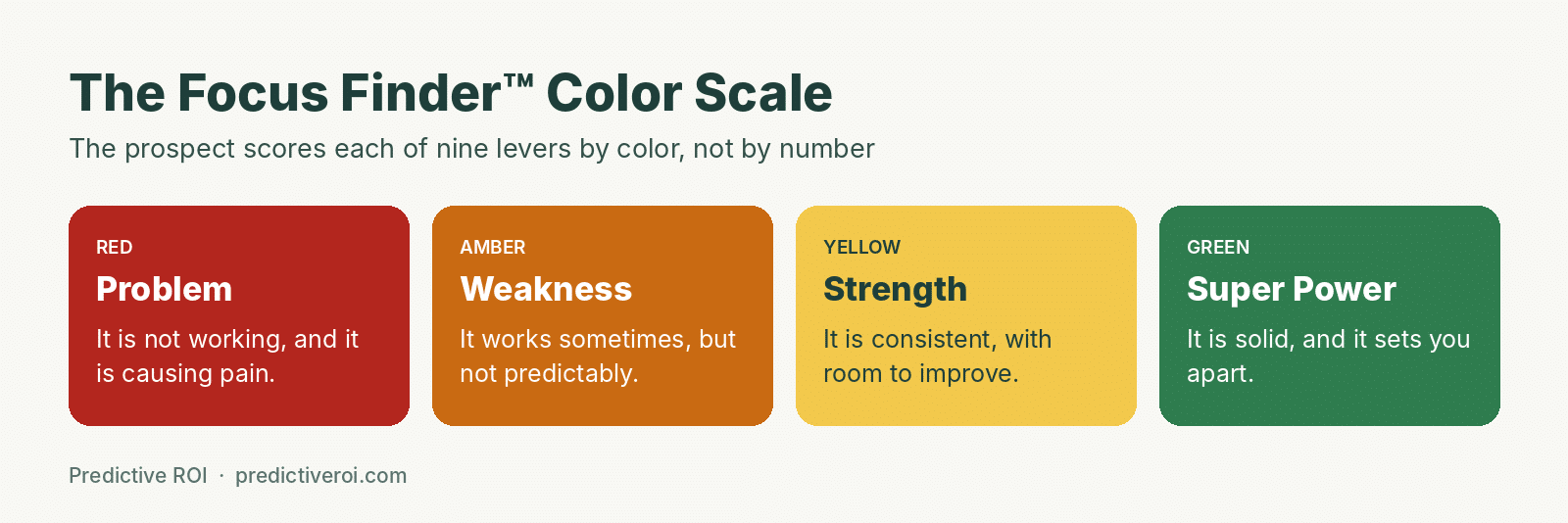
An example lever. For the lever “Determine Who You Serve” in Predictive ROI’s own Focus Finder™, red reads “We currently serve anyone and everyone.” Yellow reads “Our right-fit avatar is clear and we have a list of 25 prospects right now.” Green reads “We’re recognized as an authority within a niche and right-fit prospects seek us out.”
Note: Predictive ROI has updated the Focus Finder™ since this episode aired. The current version follows the nine strategies of the In-Demand Agency Methodology™.
“The Focus Finder isn’t about proving who’s right. It’s about seeing what’s true.”
2. Score With Colors, Not Numbers
Asked for a number, people debate the difference between a 6 and a 7. They intellectualize and protect their ego. Stephen Woessner says color is intuitive and immediate. When a prospect moves a lever from amber to red, it is a small admission that something they have been calling fine is not, and they only say it aloud when they feel safe.
“Color removes that noise.”
3. Lead the Alignment One Lever at a Time
Predictive ROI’s approach, as Stephen Woessner describes it:
- Share your read on one lever, based on what you heard in Help Me Understand, then pause.
- Ask “What makes you say Amber?” and let the silence work.
- Ask “What would have to change for it to shift one step healthier to the right?”
- Look for tension between colors, such as a green pipeline beside an amber sales process, and ask what causes the gap.
- When patterns appear, say “Here’s what I’m noticing. Does that feel accurate?”
That last question matters most to him. It invites confirmation instead of compliance.
“They’re not agreeing with you. They’re agreeing with themselves.”
4. Prescribe Only What You Diagnosed Together
Once alignment is solid, the prospect’s unspoken question is “Okay, so now what?” Stephen Woessner describes four steps:
- Validate the alignment. Confirm that what you heard is an accurate reflection before you talk about what might fix it.
- Introduce your solution at a high level. Give a 30,000-foot view, with an offer to go as granular as they want in another session, “in full transparency.”
- Paint the outcome. Stephen Woessner shows three pictures from his iPad: a dry desert for the pipeline today, a mountain stream for a steady flow of right-fit prospects, and a barrel of fish for a pipeline where a right-fit client is there whenever the agency needs one.
- Invite the next conversation. Offer a Meet & Greet with the people who will lead the work.
“You validated before advising. You taught without selling.”
What Does an Align & Prescribe Session Sound Like?
Stephen Woessner recounts an anonymized session with a mid-sized agency. Things looked solid from the outside. Inside, leads were inconsistent and margins were slipping. The founder arrived saying, “We just need to fix biz dev.”
On the first lever, Determine Who You Serve, the founder answered with confidence: “Amber. We’ve got our niche nailed.” Predictive ROI’s team asked, “If one of your clients was describing you to someone else, what niche would they say you serve?” After a long pause: “Probably clients in B2B industries.” Asked whether amber still felt accurate, the founder said:
“If I’m honest, that’s red.”
The agency’s founder, as recounted by Stephen Woessner
The next levers followed. Later the founder admitted, “I think we’ve been calling things Amber because we don’t want to admit how messy they are.” The reply from Predictive ROI’s team: “The color doesn’t judge, it just helps us see where the effort needs to go.” The founder’s team began adding their own reds.
One lever went the other way. The founder called it “Green. Definitely green!” because clients pay compliments. Asked “Do you have a formal feedback system?”, the founder laughed: “Okay, maybe we’re Yellow.” Stephen Woessner reads that laugh as proof of safety. By the end, the founder said:
“I came in thinking our problem was X. Now I think that Y is our problem.”
The agency’s founder, as recounted by Stephen Woessner
Stephen Woessner calls that the sentence to wait for in every session: the prospect naming the real issue in their own words.
What Are the Five Lessons of Align & Prescribe?
- Slow down to speed up. Rushing to a solution removes the space a prospect needs to think. “Pause long enough for the truth to catch up.”
- Trade persuasion for perspective. “Let’s look at this together” replaces “here’s what you need next.”
- Anchor every insight in feeling, not fact. When a prospect says red, do not rescue them. Ask, “What makes it red?”
- Prescribe only what’s been co-diagnosed. If the prospect did not help identify the problem, they will not fully believe the prescription.
- Show the architecture. Name the process and the next step as you go. It shows you have a system, the system has a purpose and there is a next step.
“People don’t argue with something they helped create. They defend it.”
What You Will Learn in This Episode
- Why alignment is the missing ingredient in most agency sales conversations
- How to build a Focus Finder™ from three strategies and nine levers
- Why a color scale gets more honest answers than a 1-to-10 score
- The questions that let a prospect move from perception to truth
- Four steps for prescribing without pitching, and how to set up the Meet & Greet
Put the Episode Into Practice
- Write down your three core strategies and the three levers under each.
- Draft a red, amber, yellow and green statement for every lever.
- In your next second meeting, share the diagnostic and ask the prospect to pick the colors.
- After each answer, ask “What makes you say that?” and wait.
- Before you recommend anything, say what you are noticing and ask, “Does that feel accurate?”
Key Terms From This Episode
- Align & Prescribe
- Align & Prescribe is the second conversation in the Trust Architecture™, where the agency and the prospect confirm the diagnosis together using the Focus Finder™ before any recommendation is made.
- Focus Finder™
- The Focus Finder™ is a diagnostic an agency uses on first calls in which the prospect scores their own situation, so the prospect helps make the diagnosis instead of hearing a pitch.
- Trust Architecture™
- The Trust Architecture™ is Predictive ROI’s three-session sales process, made up of Help Me Understand, Align & Prescribe and Meet & Greet, that moves a right-fit prospect from curiosity to yes without pitching or pressure.
- Help Me Understand
- A Help Me Understand conversation is Predictive ROI’s replacement for the discovery call. Its only job is to understand what is happening in an agency, in the agency’s own words, and nothing gets prescribed.
- Meet & Greet
- Meet & Greet is the third conversation in the Trust Architecture™, held before the proposal is delivered, where the agency’s team teaches the prospect how the work gets done.
Frequently Asked Questions
What is Align & Prescribe?
Align & Prescribe is the second conversation in the Trust Architecture™, where the agency and the prospect confirm the diagnosis together using the Focus Finder™ before any recommendation is made.
What is the Focus Finder™?
The Focus Finder™ is a diagnostic an agency uses on first calls in which the prospect scores their own situation, so the prospect helps make the diagnosis instead of hearing a pitch.
What do the Focus Finder™ colors mean?
Red is a problem, amber is a weakness, yellow is a strength and green is a super power. Stephen Woessner says the prospect chooses a color for each of nine levers.
Why does the Focus Finder™ use colors instead of numbers?
Stephen Woessner says a 1-to-10 scale makes people overthink and protect their ego. Color is intuitive and immediate, so a prospect feels the answer before rationalizing it.
Why is “Does that feel accurate?” so important?
It invites confirmation instead of compliance. When a prospect agrees that an observation feels accurate, Stephen Woessner says, they are agreeing with themselves, so the insight sticks.
Is the prescription a proposal?
No. It is a high-level view of the solution, grounded in what the prospect diagnosed, followed by an invitation to a Meet & Greet with the people who will lead the work.
Can Align & Prescribe be combined with the first meeting?
Stephen Woessner keeps them separate. Help Me Understand earns trust by listening. Align & Prescribe protects that trust by confirming the diagnosis with the prospect before anything is recommended.
Can an agency get a copy of Predictive ROI’s Focus Finder™?
Yes. In the episode, Stephen Woessner offers to send it to anyone who emails him at [email protected].
Continue the Series
- Episode 173: The Trust Architecture™. The overview of all three sessions.
- Episode 176: Help Me Understand. The session that comes before this one.
- Episode 189: The Research Behind Building Trust Faster, with Susan Baier and Hannah Roth. Why buyers start from distrust.
Research Notes and Sources
- Client examples. The Align & Prescribe session and the “tale of two agencies” are anonymized or illustrative accounts told by Stephen Woessner in the episode. Quotations appear as he recounted them.
- The Focus Finder™. The example lever and color statements are from the version taught in October 2025. Predictive ROI has since updated the tool.
- Meet & Greet. The episode previews a solocast on the third session. That solocast was not recorded. The overview of Meet & Greet is in Episode 173.
- Script and audio. The text below is Stephen Woessner’s script, edited lightly. Where the script and the recording differ, the audio is the authoritative version.
Resources
- A copy of the Focus Finder™: email [email protected]
- Predictive ROI’s Resource Library, including the book Sell with Authority
- How to Fill Your Sales Pipeline, our free Facebook group
Your Right Next Step
If you want to see how alignment works before you build your own Focus Finder™, start with a Help Me Understand conversation with our team. Nothing gets prescribed. Reach out here and we’ll compare calendars.
Onward with gusto!
About Stephen Woessner
Stephen Woessner is CEO of Predictive ROI, host of The In-Demand Agency Podcast and co-author of Sell with Authority. Meet the Predictive ROI team or connect with Stephen on LinkedIn.
This is Stephen Woessner’s script for the episode, edited lightly for readability. The audio remains the authoritative version.
Welcome back, friends, to the Sell with Authority podcast.
I’m Stephen Woessner, CEO of Predictive ROI — and today’s episode is a solocast.
No guest — just you and me talking through a topic that — in my opinion — sits at the center of how agencies win new business today.
And that’s Trust and Alignment.
If you listened to Episode 176, you and I walked through the process we use to set what we call “the first brick” of our Trust Architecture sales process.
We call that first brick our Help Me Understand session.
It’s during a Help Me Understand session when trust between you and your prospective client…begins.
During Help Me Understand is where you resist the temptation to pitch — and instead — you listen so deeply that your prospect feels seen and truly heard.
It’s where you create enough safety for trust and truth to enter the room.
But earning trust is only half of the recipe. Protecting the trust that you built is the other half.
And that’s where it can be easy for an agency to slip up during the sales process.
Let me paint the scene.
You’ve just run a well-orchestrated Help Me Understand session.
Your prospect shared openly. You listened.
They smiled. They nodded.
You can feel trust and maybe even a little bit of momentum building.
Then someone on your team — maybe even you — said, “Awesome, thanks for all of the details…here’s how we think our team can help.”
On the surface — it’s an innocent enough statement.
But then…
You see your prospect’s shoulders tighten, and you feel the energy shift.
The conversation that once felt like a collaboration now suddenly feels like a pitch.
That tiny moment is where distrust loudly steps back into the room.
The prospect doesn’t say it, but inside they’re thinking:
“Oh, I see. This was never about me — it was about your sale.”
And just like that — the trust and rapport you worked hard to build evaporates.
We’ve all been there. I know I certainly have.
Not because we’re pushy — but because we care.
We fall in love with all of our prospects’ problems. We know we can help, and we jump too soon.
But when we move from “I understand you” to “Here’s what you need” without alignment, we unintentionally break the very trust we hoped to earn.
And that’s exactly why I recorded this solocast for you.
Today, we’re installing the second brick in The Trust Architecture™ into place.
The second brick is the conversation we call Align & Prescribe.
It’s during Align & Prescribe — or A&P for short — where you turn empathy into alignment.
A&P will act as the bridge between understanding and action.
And if you follow this process with excellence — I promise you — this will be the conversation that makes every proposal afterward feel like a natural next step for your prospect instead of a pitch.
Agencies typically don’t have this bridge in their sales process.
Instead — they finish a discovery call and jump straight to solutions.
Here at Predictive — we don’t. We slow down. We align first.
And we teach our clients and their teams how to do the same.
Inside the A&P session — alignment happens through a diagnostic we call The Focus Finder.
It’s the tool that turns subjective opinions into shared truth.
It gives both your prospect and you a way to look at their business together and see the same thing.
And the person who guides that conversation is someone who embodies the word “advocate.”
Here at Predictive — that person’s official title is Partner Advocate.
It’s not a sales or marketing title. It’s a mission.
Our Partner Advocate’s role is to advocate for our prospective clients…our partners.
Our team helps them see their agency through a new lens and make decisions with confidence.
We don’t pressure. We don’t rush.
We lead a conversation that feels like a trusted colleague sitting across the table, helping you think through what matters most.
When our team leads a session, there’s no sales script.
Just curiosity, structure, and a steady tone that tells the agency owner: “I’m on your side.”
One of our clients recently said, “Being in a conversation with [our team] feels like being in a business therapy session — but without the awkward part.”
That’s because our team makes alignment safe.
And safety is the currency of trust.
When an agency leader sees how this works — how you can run a diagnostic conversation that builds alignment instead of tension — it can change everything about how your agency approaches biz dev.
And friends — that’s what this solocast is about.
You and I are going to walk through…
1. Why alignment is the missing ingredient in most sales conversations
2. How The Focus Finder diagnostic creates a shared understanding between you and your prospect
3. What our team models that you can take and apply into your agency right away.
4. How to move from Alignment to Prescription without pitching
5. And how to tee up “Meet & Greet” — the next brick in the Architecture — so that it feels like a smooth and natural transition As we dive in today, I want you to keep this key piece front and center — it’s the red thread that connects everything we’re about to discuss…
We never, ever prescribe until we’ve aligned.
Okay — here we go…
First — let’s talk through the real reason so many agency new business conversations stall — even when everything seems to be going well.
It’s not because your agency doesn’t care.
It’s not because your prospect doesn’t have a budget.
And it’s rarely because your work isn’t impressive.
It’s likely because you’re not yet aligned.
You see the situation one way.
And your prospective client may see it another.
And the moment those two versions of truth start drifting apart — trust begins to leak through the cracks.
It’s so easy for an agency to leave a conversation with a prospect and the team members say to themselves…
“We totally get them.”
Meanwhile, the prospect leaves thinking, “They sort of get us — but they’re already thinking about what they want to sell.”
And that’s the moment trust starts to wobble.
Let’s think about it this way…
Imagine your doctor — before you even finish describing the symptoms you’re experiencing — says, “Here’s the medication you need.”
Even if your doctor was right, you’d hesitate, wouldn’t you?
Because you weren’t part of the diagnosis.
I promise you — your prospects feel the exact same way.
They don’t just want to be understood — they want to see the diagnosis with you.
That’s alignment.
I’ll illustrate by sharing a short story — let’s call it the Tale of Two Agencies.
Agency A runs a solid discovery call.
They ask good questions, capture notes, and it ends with, “Give us a few days to pull together some recommendations.”
They write a thoughtful proposal, send it off, and wait.
Then the email lands: “We really enjoyed the conversation, but we’re going in a different direction.”
They replay everything in their head. “What did we miss?”
Candidly — they missed alignment.
Because in the prospect’s mind, the problem wasn’t “X” — it was “Y”.
Unfortunately — for Agency A — they solved the wrong problem beautifully.
Now let’s take a look at Agency B.
They take a different path.
Before the close of the first conversation, they asked permission to schedule an “Align & Prescribe” session with the prospect.
And they open the A&P session saying…
“Let’s look at your business together through nine growth levers. We’ll identify where things are strong, where there’s friction, and where we might need to focus next to ensure you reach your goals.”
They pull up their diagnostic…something they call The Focus Finder.
The prospect chooses colors — red, amber, yellow, green — for each lever.
Five minutes in, the prospect pauses on “Marketing Engine” and says, “We’re amber here. Wait, actually, maybe even red.”
Everyone on the prospect’s team nods in agreement.
For the first time, everyone in the room is seeing the same problem, at the same time, using the same language.
That’s alignment.
And during the second half of the session — the “Prescription” isn’t a guess. It’s based on everything the prospective client shared.
Agency B has positioned itself well to win a new client.
Friends, the alignment you build protects the trust you earned.
If the first brick — the Help Me Understand session — builds trust — then the Align & Prescribe session — protects the trust you’ve built.
Now, let’s work our way through the centerpiece of the A&P session — The Focus Finder.
The Focus Finder is a visual diagnostic, but it’s not a spreadsheet or an overly designed slide deck.
And if you’d like a copy of Predictive’s Focus Finder — just email me at [email protected] and I’ll be sure to get you the PDF.
For now — I want you to think of 3 core strategies that you and your team would typically implement to ensure your client gets the result outcomes they are looking for.
In a Google Doc or on a whiteboard — please write down the three strategies. Short and concise. Just a couple of words for each.
You can come back and refine the three later.
Okay — now that you have the 3 strategies identified — next I want you to identify three tactical steps, or levers, that you and your team would implement to make each strategy come into fruition.
So, for example…for your Strategy 1…please jot down 3 tactics or tactical levers…that if your team executes the three tactics over and over again with excellence…then Strategy 1 will be accomplished and your client will receive the outcome tied to Strategy 1.
And then repeat that same process for Strategy 2 and Strategy 3.
So when you are finished with this initial exercise – you will have identified 3 Strategies as well as the 9 tactics that will make all of this work.
3 Strategies…9 tactics that when executed with excellence…deliver the result outcomes to your clients…which were the point of the Strategies.
Does all of that feel okay so far?
If you have any questions or concerns — send me an email and I’ll share Predictive’s Focus Finder and you can use it as a guide as you build your own.
Okay — let’s keep going.
For each of the 9 tactics — you’ll now need to create the color scale along with a brief narrative that describes what each color represents for your prospect.
For example — inside Predictive’s Focus Finder — we call tactic #1: Determine Who You Serve.
It’s the first of 3 tactics in our first strategy to helping an agency sell more of what they do.
That first strategy is what we call GROW. And the result outcome to GROW is “helping an agency own their addressable market.”
And…we know that in order to own an addressable market…an agency must GROW their audience…and in order to do that…they must determine who they serve.
– So – we have GROW as Strategy #1
– We have “own your addressable market” as the outcome to the GROW strategy.
– And we have “Determine who you serve” as the first of three tactical levers that we would pull over and over again to deliver the outcome.
So let’s look a bit closer at “Determine who you serve” and the color scale.
We use Red, Amber, Yellow, and Green as the scale.
For example…
🔴 Red means Problem. It’s not working. It’s causing pain.
🟠 Amber means Weakness. It works sometimes, but not predictably.
🟡 Yellow means Strength. It’s consistent but has room for improvement.
🟢 Green means Super Power. It’s solid — the thing that sets you apart.
So in the case of “Determine Who You Serve”…here’s our color scale as well as each of the narratives for each color.
Red: We currently serve anyone and everyone.
Amber: We want to go more narrow into a niche, but we lack the specific criteria to make that possible.
Yellow: Our right-fit avatar is clear and we have a list of 25 prospects right now.
Green: We’re recognized as an authority within a niche and right-fit prospects seek us out.
So now let’s go back to your 9 tactics.
To build your own Focus Finder…
You’ll need to map out short narrative statements that communicate what red looks like, or amber looks like, or yellow, or green.
Short statements that when you read them out loud for your prospective client…they can see themselves within one of the statements.
Now that we have some broad strokes in place for building your own Focus Finder — I want to shift our attention back to our team and how we use the diagnostic during an actual A&P conversation.
As we help one of our prospective clients score themselves — we first share our perspective on what we think the score might be based on the context shared during the Help Me Understand session.
This is a wonderful opportunity for you to demonstrate how much you learned from that session and how it matters going forward.
When our team is leading an A&P — we share what we believe the prospect’s score is for each tactical lever.
But we only share one score at a time.
We share the score, and then we pause.
The pause is intentional. It’s our way of signaling that this isn’t a test.
There’s no right or wrong answer.
There’s only honesty.
Color instead of numbers — because color speaks to emotion, not intellect.
When your prospect says “Amber” in the moment — they feel it before they rationalize it.
But when they change their mind and admit “Red,” they don’t need to justify it — they just know.
And that’s the genius of The Focus Finder.
It invites alignment.
For example…
Our team will ask a Predictive prospect about the first lever — “Determine Who You Serve” — and our prospect will say, “I think we’re amber here.”
We nod gently and follow up with the question, “What makes you say Amber?”
Then comes the silence.
And if you’ve ever been in a conversation with our team, you know we’re not afraid of silence.
We let it hang in the air just long enough for the truth to bubble up.
Our prospect may shift in their chair and finally say, “Well, we’re known in our industry, but I’m not sure people could tell you what we’re known for.”
We smile.
“That’s helpful. Given that, do you still feel amber fits — or would red be more accurate?”
A quiet laugh from the prospect. Then a sigh. “Yeah…
probably red.”
That’s alignment happening in real time.
No pressure. No debate.
Just your prospect moving from perception to truth — safely.
Our team approaches every lever like a Partner Advocate — not a salesperson.
The goal isn’t to collect data per se. It’s to create safety.
Because safety leads to honesty. And honesty leads to alignment.
When you lead with advocacy, prospects will feel more comfortable sharing their truth.
And once truth is on the table, your path forward becomes much more obvious.
And sometimes, the insight doesn’t come from a red.
It comes from the tension between colors.
A prospect might say their “Pipeline” is green, for example, but their “Sales Process” is amber.
Our team will ask, “That’s interesting — what do you think causes that gap?”
You can watch the gears turn. Then an excellent, multi-layered discussion unfolds.
Boom. Alignment.
That’s what happens when your prospects start taking ownership of the conversation.
Your prospects are not being audited — they’re self-assessing.
They start connecting dots you couldn’t connect for them.
You can almost feel the relief wash over them as they say, “Wow — that makes so much sense.”
Because The Focus Finder isn’t about proving who’s right.
It’s about seeing what’s true.
There’s a reason color works better than numbers in these moments.
When you ask someone to rate themselves on a 1–10 scale, they overthink it.
“What’s the difference between a 6 and a 7?”
They intellectualize. They protect their ego.
Color removes that noise.
It’s intuitive. Immediate. Honest.
And when someone moves a lever from amber to red — that’s not just a new color on a chart.
That’s a micro-moment of vulnerability.
It’s an admission: “We’ve been pretending this is fine — but it’s not.”
And the only reason they can say that out loud is because they feel safe.
Our team makes it safe. And your job is to make your prospects feel safe, too.
Our pace tells them they don’t need to rush.
Our tone tells them they’re not being judged.
And that combination — is what turns a simple diagnostic into a breakthrough experience.
By the time the conversation moves through all nine levers, a pattern emerges.
You’ll see clusters of amber and red — usually around the same two or three themes.
But our team never says, “Here’s what you need to do.”
Instead — what we say is, “Here’s what I’m noticing — does that feel accurate?”
That phrase — “does that feel accurate” — might be the most important sentence in the entire process.
It invites confirmation instead of compliance.
It turns insight into alignment.
Because when your prospect agrees that something “feels accurate,” they’re not agreeing with you — they’re agreeing with themselves.
And when they own that insight, it sticks.
Before I pull back the curtain into a real A&P session — let’s do a quick recap…
The Focus Finder isn’t about data — it’s about dialogue.
It’s not about judgment — it’s about accurate alignment.
Okay — now let’s step through an actual Align & Prescribe session so you can see how it all unfolds.
The names and details are anonymized, but everything you’re about to hear really happened.
Picture this: a mid-sized agency — smart, experienced, respected in its niche.
From the outside, things looked solid. Good clients, steady revenue, and an energetic team.
But inside? The founder felt the pressure.
Leads were inconsistent, and margins were slipping.
They came to Predictive saying, “We just need to fix biz dev.”
That was the surface problem — at least, that’s what they believed.
Our team began the A&P session exactly the way we always do: slow, calm, clear.
“Let’s look at your agency together,” our team said, sharing The Focus Finder screen.
“No wrong answers. We’ll take each tactic one at a time.
You tell me where you think you are.”
The First Lever: Determine Who You Serve.
The founder smiled confidently. “Amber. We’ve got our niche nailed.”
Our team nodded. “Great. What makes you say Amber?”
A pause.
“Well, we have a clear audience… we think.”
Our team’s voice stayed even. “If one of your clients was describing you to someone else, what niche would they say you serve?”
Another pause — longer this time.
Then finally… “Probably clients in B2B industries.”
Our team let the silence hang, then smiled. “That’s valuable — but is that what you want to be known for?”
A small laugh. “Not exactly. We want to be known for serving clients in a very specific niche — and moving the needle for companies in that niche.”
“So given that,” our team said gently, “would Amber still feel accurate?”
The founder looked down, then back up. “If I’m honest — that’s red.”
There it was. The first shift.
You could almost feel the exhale through the screen.
Because admitting red in that moment doesn’t feel like failure — it feels like truth.
And truth feels lighter.
That’s part of our team’s magic: we don’t rush to correct or to praise.
We simply create the pause where alignment can appear.
Then our team helped move through the next few tactical levers.
Offer Design — Amber.
Biz Dev Engine — Amber sliding toward Red.
Pipeline & Sales Process — definite Red.
Every time the founder hesitated, our team asked a short, open-ended question:
“What makes you choose that color?”
“What would have to change for it to shift one step healthier to the right?”
We never said “should.”
We never said “must.”
Our team simply invites reflection.
At one point, the founder sighed.
“You know, I think we’ve been calling things Amber because we don’t want to admit how messy they are.”
Our team smiled softly. “That’s really common. The color doesn’t judge — it just helps us see where the effort needs to go.”
The tone in the room changed.
Defensiveness melted. Curiosity replaced it.
The founder leaned in. The team started adding their own thoughts.
One said, “If we’re being honest, client reporting is Red too.”
Another chimed in, “Yeah, and our follow-ups.”
Within minutes, they realized our team wasn’t here to evaluate or judge them — they were collaborating.
That’s alignment.
Halfway through the session, they reached a tactic and the founder beamed…
“Green. Definitely green!”
Our team nodded. “That’s wonderful. How do you know you’re Green?”
“Well — our clients say so. We get compliments.”
Then our team asked, “Do you have a formal feedback system?”
“Not really.”
Silence.
Then laughter. “Okay — maybe we’re Yellow.”
That laughter — that tiny moment of humility — is what tells you that trust is alive and well between you and your prospective client.
Because nobody laughs about a weak spot unless they feel safe.
From there, the conversation flows and patterns emerge.
The founder said, “I came in thinking our problem was X. Now I think that Y is our problem.”
Our team smiled. “That’s a really valuable distinction.”
That’s the sentence you wait for in every Align & Prescribe session — the moment of ownership.
Because once a prospect identifies — FOR THEMSELVES — their real business issue in their own words, your job changes completely.
You’re advocating for your prospect.
Okay — I want to share a quick behind-the-curtain look into Predictive for a minute.
After the session, our Partner Advocate shared what stood out.
Our Partner Advocate said, “They already trusted Predictive from our Help Me Understand session. My goal wasn’t to add more trust during Align & Prescribe. It was to protect what we’d earned by helping them see themselves.”
That’s an important mindset shift, friends.
The typical agency biz dev person tries to prove and persuade.
But an advocate doesn’t try to do that at all. The goal is to align.
And it helps that one of our team’s superpowers is patience.
We don’t jump in to fix. We hold space for insight to surface.
And because we do that, prospects align themselves — without ever feeling pushed.
It’s the reason our sessions end with sentences like:
“This was incredibly helpful — thank you.”
Or, “We’ve never looked at our agency like this before.
Thanks for helping us see things more clearly.”
Those aren’t compliments; they’re confirmations that The Trust Architecture is working.
Each brick in the Architecture does its job, so the next one doesn’t have to overperform.
Help Me Understand earns trust.
Align & Prescribe earns alignment.
And next, your Meet & Greet session will earn commitment.
You’re building something stronger than a sales funnel — you’re building a relationship framework that scales.
Before we walk through the Prescription step of Align and Prescribe — let’s step back from the story and review five key lessons that elevate A&P beyond a diagnostic — into an alignment engine that protects and multiplies trust.
Lesson 1: Slow down to speed up
This first lesson might sound counterintuitive.
In a fast-paced sales world, slowing down feels like losing momentum. But inside The Trust Architecture, slowing down creates momentum.
Every time you rush to present a solution, you compress the space that your prospect needs to think.
And when they don’t have time to think — they don’t have time to trust.
Our team models this beautifully.
The pacing inside the session feels deliberate — even peaceful.
We let silence do the heavy lifting.
When a prospect says, “We’re amber,” we don’t immediately jump to the next question.
We wait — and I promise you — there is power in the pause.
Because in that small pocket of silence, reflection happens.
It’s in that space that prospects admit, “You know what… maybe we’re red.” And that single admission changes everything.
So when you’re orchestrating your own A&P sessions — pause long enough for the truth to catch up.
Lesson 2: Trade persuasion for perspective
If Help Me Understand was about replacing pitching with listening, then Align & Prescribe is about replacing persuasion with perspective.
Here’s what I mean.
The typical agency goes into the second meeting ready to persuade:
“We’ve analyzed your data.”
“We’ve mapped your competitors.”
“Here’s what you need next.”
All well-intentioned, but the second those words hit the air, the prospect’s walls go up.
Because persuasion — even polite, helpful persuasion — can still feel like pressure.
But perspective feels different.
Perspective invites participation. It says to your prospect, “Let’s look at this together.”
That’s what The Focus Finder does.
It replaces the monologue of persuasion with the dialogue of perspective.
When you show a prospect the 9 tactics in your Finder — and because of your experience in working with clients that look just like them — the tactics in your Finder likely match perfectly with what’s going on inside their business — and you say, “Let’s color these together,” you’re creating a seismic shift from salesperson/prospect to partner/partner.
That’s how you keep trust intact.
Lesson 3: Anchor every insight in feeling, not fact
Data’s important — but emotion drives decision-making.
You can show charts, metrics, testimonials — and those help — but what makes alignment stick is when your prospect feels the truth of what they just said.
That’s why The Focus Finder uses colors instead of numbers.
Color is visceral.
When a prospect calls a lever red, it doesn’t require debate.
You can see it in their expression — relief, sometimes grief — because that color feels real.
And that’s where a calm presence matters most.
When someone says, “We’re red,” we don’t rescue them with reassurance.
We let the color sit there — and then softly ask, “What makes it red?”
That question connects the intellectual acknowledgment to the emotional reality.
And when they describe it, they start to feel ownership.
When both parties feel the same truth, trust locks in place.
Lesson 4: Prescribe only what’s been co-diagnosed
This is the line that separates The Trust Architecture from other sales frameworks.
It’s tempting — right after alignment — to jump to solutioning.
But you can’t skip co-diagnosis. And here’s why:
If the prospect doesn’t help identify the problem, they’ll never believe your prescription fully solves it.
Co-diagnosis is what makes a prescription credible.
That’s why at Predictive, we never use Align & Prescribe to pitch. We use it to validate.
We’ll say things like, “It sounds like your biggest friction is around building a predictable pipeline of right-fit prospects.
Does that feel accurate?”
That phrase — does that feel accurate? — is the bridge between alignment and prescription.
It invites confirmation.
It transforms “our recommendation” into “our shared plan.”
While other agencies are presenting decks, you’re co-authoring a strategy alongside your prospect.
And people don’t argue with something they helped create. They defend it.
That’s what co-diagnosis does: it turns your prospect into your advocate.
Lesson 5: Show the architecture — don’t hide it
Transparency is trust.
When you show your prospective client the structure behind your process, you’re not giving away your secret sauce — you’re proving you have one.
When our team walks a prospect through Align & Prescribe, we don’t hide the playbook.
We name the process as we go:
“This is where we move from understanding to alignment.
In our next session, we’ll look at commitment and fit.”
That single sentence tells the prospect three powerful things:
1. You have a system.
2. The system has a purpose.
3. The system has a next step.
That’s what turns a casual sales call into a guided journey and process.
When prospects see that you have a framework — they stop wondering if you’re winging it and they start trusting that you’ll bring the same order to their chaos.
Okay, friends — now that we have Align dialed in — let’s step through how to complete the Prescribe step.
Once alignment is solid, prospects always ask the same unspoken question:
“Okay … so now what?”
That’s where “Prescribe” begins.
The Prescribe step is the bridge between understanding the problem and designing a path forward.
And if you get this moment right, you never have to sell again — the prescription sells itself.
There are typically 4 steps in Prescribe, and we’re going to work our way through each.
Step 1 — Validate the Alignment
Our team always opens the prescription conversation by recapping validation, not advice.
We’ll say something like:
“What we wanted to do today was, first, validate what we heard. Was this an accurate reflection?
Then, at least at a high level, we could share an overview of what our solution looks like for bridging the gaps in each of these areas.
If it resonates, we can always do another call where we deep-dive into what that engagement would look like.”
The way our team frames up Prescription keeps the prospect in co-ownership.
We are not shifting from “Advocate” into “sales mode.”
We’re confirming that what we heard is true before we talk about what might fix it.
Step 2 — Introduce The System
Then I’ll step in and expand the frame…
“Perfect. What we’ll do next is walk you through what we call the executive summary — let’s call this a 30-thousand-foot view of The System.
And afterwards — if you’re game, we’ll schedule another session and slice apart The System as granular as you’d like. We teach and share everything — in full transparency.”
That phrase — in full transparency — disarms every ounce of defensiveness.
Because candidly — we’re not withholding; we’re inviting.
The goal during Prescribe isn’t to impress with complexity.
It’s to show how The System serves as the bridge between what’s Red and Amber today — and what could soon be Green as a result of The System.
Okay, Step 3 — Paint the Outcome.
I’ll usually share some visuals that help bring the System to life…
For example…
“Agencies will typically describe their sales pipeline as dry, dusty, barren…not sure where their next new client will come from.”
And I will share a visual of a hot, dry, desolate desert from my iPad.
And then I will say…
“But what we’d like your sales pipeline to look like is a steady stream of right-fit prospects flowing into your agency.”
And I will share a visual of a fast-moving, cool, mountain stream from my iPad.
Then I will say…
“But we think we can do even better. What we’d really like your sales pipeline to look like is this…”
And I will share a visual of a barrel of fish…the exact same kind of fish…from my iPad.
Then I say…
“That’s what The System is designed to do — to make your pipeline look like a fish in a barrel. Whenever you need a client, they’re already there — being nurtured, being cared for, ready to work with you.”
That’s the moment when the prescription lands.
They can see it.
It’s tangible, not theoretical.
And then I’ll connect the promise to the process:
“The result outcome is that we’ll help you install a biz-dev engine that serves up right-fit prospects on repeat — and none of it is guessing. Data lights the path.”
Notice — I’m not pitching here.
I’m teaching.
I’m showing cause-and-effect between what they just uncovered during Alignment with The Focus Finder and how we can Prescribe The System to solve it.
Step 4 — Invite the Next Conversation
Then our team invites the next conversation without applying any pressure or sales closing techniques.
“If you and your team are game for this, Stephen and I will invite Hannah and Libby to join us — and we’d like for you to meet the scientists who run point on our System engagements.
Then we can have a very open, candid conversation about the sticking points and how we’ve worked around those — in full transparency.”
That’s the handoff to Meet & Greet.
It’s not a close. It’s continuity to the third brick in The Trust Architecture.
I promise you — if you follow this same recipe in your sales process — by the end of your Align & Prescribe session, your prospect won’t be wondering what happens next — they’re anticipating and looking forward to your Meet & Greet session.
They’ve already said yes in principle to your Prescription because what you highlighted as a possible solution grew out of their own diagnosis.
Prescription done this way protects every ounce of trust you built in Help Me Understand and every ounce of alignment you earned in Align & Prescribe.
You validated before advising.
You taught without selling.
You invited and didn’t propose anything.
That’s the rhythm of The Trust Architecture™.
Help Me Understand earns the trust.
Align & Prescribe earns alignment and sets forth a prescription that is based on the alignment that was gained.
And through the entire process — you earn momentum — the bridge to commitment.
That’s how you move from understanding to action, without ever breaking the trust you worked so hard to build.
Okay, friends — it’s about time that we need to come in for a landing.
We’ve covered a lot — so before we look ahead, let’s anchor what we’ve built together today.
You now have a complete view of Align & Prescribe, the second brick in The Trust Architecture™.
The Trust Architecture isn’t theory.
It’s not a clever sales metaphor.
It’s an agency sales process that works, and it’s a system that transforms how agencies like yours can build relationships and earn confidence while working alongside your prospects.
The first brick — Help Me Understand — earns trust.
It’s the conversation where you slow down, listen deeply, and make your prospect feel seen, heard, and understood.
The second brick — Align & Prescribe — earns alignment.
It’s where you and your prospect start seeing the same picture together.
And soon, the third brick — Meet & Greet — will earn commitment.
It’s where alignment turns into action, and a conversation becomes a client.
That’s the sequence.
Trust. Alignment. Commitment.
And when you apply the full Trust Architecture — that calm, structured confidence — your agency’s biz dev changes.
Because then, your sales process isn’t something you endure.
It’s something you and your prospect actually enjoy.
You start looking forward to these conversations again — because you’ve created a collaborative environment where prospects choose you because they trust you.
Okay, so what comes next?
The third and final brick in The Trust Architecture™ is the conversation we call Meet & Greet.
This is the conversation where everything you’ve built so far turns into forward motion.
It’s where you move from alignment into action with your prospect.
From seeing the problem together to deciding how to solve it…also…together.
It’s where you and your prospect discuss how to work together, not whether to.
And when Meet & Greet is orchestrated with excellence, it doesn’t feel like a closing conversation.
Meet & Greet will feel like a beginning.
Okay…whew.
Before we close out and say goodbye, friends — I want to say thank you.
We all have the same 86,400 seconds in a day, and I am grateful that you chose to spend some of your valuable time with me listening to this solocast.
It is not lost on me that your task list is long and the fires that need your attention are plenty.
But you’re here and I’m grateful for that.
Thank you!
And if you’d like a copy of the Predictive Focus Finder – just drop me a note at [email protected] and I’ll send it your way.
Until next week — onward with gusto!
The Sell with Authority Podcast is for agency owners and leaders who want to grow a thriving, profitable agency that can weather the constant change that seems to be our world’s reality.